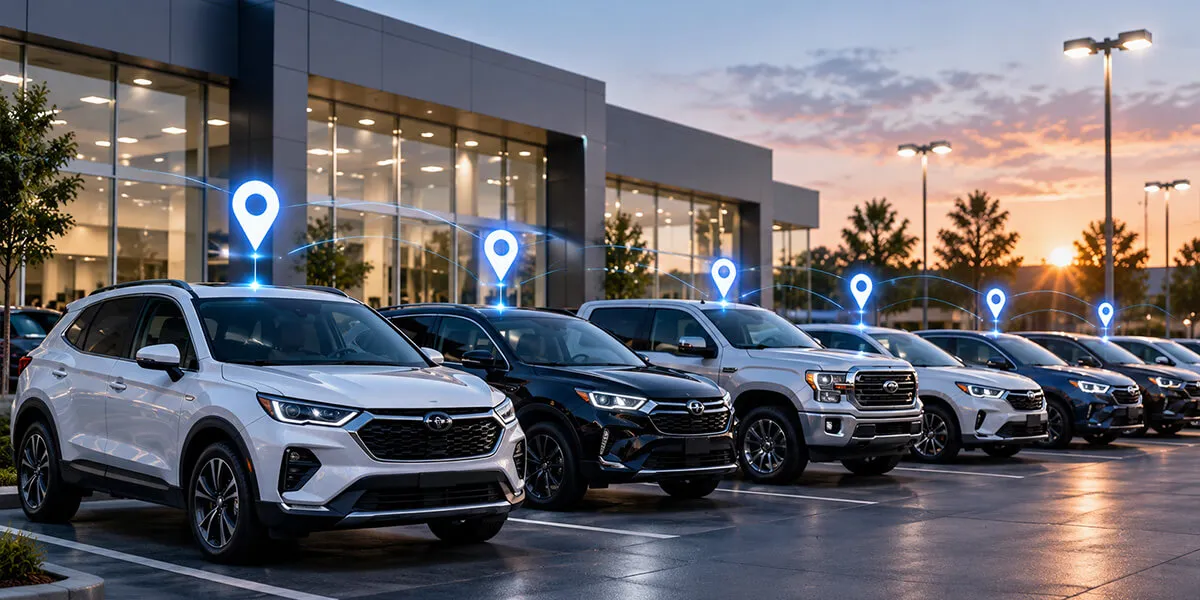
GPS Tracking for Car Dealerships | AVAS Automotive Data Platform
GPS Tracking for Car Dealerships: The Complete Guide for New and Used Car Dealers
For a modern car dealership, every vehicle sitting on the lot represents valuable inventory.
It also represents an operational responsibility.
Vehicles move constantly between receiving areas, inventory lots, service departments, detail, reconditioning, body shops, fuel stations, demo assignments, customer test drives, overflow lots, dealer trades, and other rooftops.
For dealership employees, a simple question can sometimes become surprisingly difficult:
Where is the vehicle?
That question is one reason GPS tracking for car dealerships has evolved from a basic location technology into a valuable dealership management tool.
A modern dealership GPS tracking system can help new and used car dealers locate inventory, improve lot efficiency, monitor vehicle movement, manage demos and loaners, establish geofences, respond to unauthorized movement, assist with theft recovery, and maintain visibility across multiple dealership locations.
But the opportunity can extend even further.
With AVAS, GPS can become more than a tool used while a vehicle is sitting on the dealership lot. The connected vehicle relationship can potentially continue after the sale, creating value for the customer while contributing authorized vehicle intelligence to a broader dealership data strategy.
That changes the role of GPS.
Instead of asking only:
"Where is this vehicle?"
dealerships can begin asking:
"How can vehicle connectivity create value throughout the entire vehicle lifecycle?"
This guide explains how new and used car dealerships can use GPS tracking, which capabilities dealers should evaluate, where GPS can create measurable operational value, and why AVAS offers a different approach to dealership GPS tracking.
What Is GPS Tracking for Car Dealerships?
GPS tracking for car dealerships uses installed vehicle tracking technology and dealership software to provide authorized visibility into the location and activity of vehicles within the dealership's inventory or connected vehicle ecosystem.
Depending on the hardware, software, configuration, and dealership use case, a dealership GPS tracking system can support capabilities such as:
Vehicle location
Inventory search
Lot management
Geofencing
Movement alerts
Unauthorized movement detection
Theft recovery
Demo vehicle monitoring
Loaner vehicle management
Multi-rooftop vehicle visibility
Vehicle activity information
Mileage-related information
Connected ownership services
The technology can serve different purposes at different points in the vehicle lifecycle.
For example:
Vehicle Arrives at Dealership
↓
GPS Installed or Activated
↓
Inventory Visibility
↓
Lot & Operational Management
↓
Theft Protection
↓
Vehicle Sold
↓
Customer-Facing Connected Services
↓
Connected Ownership
↓
Vehicle & Customer Intelligence
That lifecycle is important because it separates modern automotive dealership GPS tracking from the traditional idea of simply placing a tracker on a vehicle.
The vehicle connection can potentially become a dealership asset before, during, and after the sale.
Why GPS Tracking Matters More as Dealership Inventory Grows
The operational challenge becomes clearer when considering the scale and value of dealership inventory.
According to NADA's 2025 full-year dealership data, U.S. new-vehicle inventory finished 2025 at approximately 2.58 million vehicles, including roughly 2.10 million domestic units and 479,000 imports. NADA reported approximately 47 days' supply for domestic inventory and 41 days for imports.
NADA also reported that the average franchised dealership sold 955 new vehicles during 2025, at an average retail selling price of approximately $48,205.
That means dealership inventory represents substantial capital.
And inventory is rarely stationary.
A vehicle may arrive from transportation and move through:
Receiving → Inspection → Service → Reconditioning → Detail → Sales Lot → Test Drive → Fuel → Overflow Lot → Delivery
A used vehicle may have an even more complicated path:
Trade-In → Appraisal → Inspection → Service → Reconditioning → Body Shop → Detail → Photography → Used Lot → Test Drive → Delivery
Every additional handoff creates another opportunity for employees to lose track of where the vehicle was parked.
GPS tracking provides dealerships with another layer of visibility into that movement.
Use Case: Finding Vehicles Faster on the Dealership Lot
One of the simplest dealership GPS use cases can also be one of the most practical:
finding the car.
Imagine a customer arrives to see a specific vehicle they found online.
The salesperson checks the inventory system.
The system says the vehicle is available.
But where is it?
It might be:
On the front line
In detail
At service
In reconditioning
On an overflow lot
At another building
Being fueled
On a test drive
Temporarily moved by another employee
Now several employees begin looking for it.
Five minutes becomes ten.
The customer waits.
The salesperson becomes frustrated.
And the dealership is using paid employee time to physically search for an asset it already owns.
A car dealership GPS tracker can reduce that friction by giving authorized employees another way to identify a vehicle's location.
Instead of:
"Does anyone know where stock #12345 is?"
the process can become:
Search → Locate → Retrieve.
That may sound like a small improvement, but repeated across hundreds of vehicles, multiple salespeople, and thousands of customer interactions, small inefficiencies can accumulate.
GPS Tracking Can Improve Dealership Lot Management
Vehicle location is only one component of dealership lot management.
Dealership inventory changes constantly.
New vehicles arrive.
Used vehicles are acquired.
Vehicles are sold.
Units move between departments.
Dealer trades arrive and depart.
Some vehicles move to overflow storage.
Others move between rooftops.
An effective GPS tracking system for dealerships can provide another operational layer that helps staff understand where vehicles are physically located rather than relying solely on where a dealership system says they should be.
This distinction matters.
A DMS or inventory system may indicate:
Vehicle belongs to Store A.
GPS may help answer:
Where is the vehicle physically located right now?
Those are different questions.
For a dealership group managing multiple lots or rooftops, that distinction becomes even more valuable.
Use Case: Multi-Rooftop Dealership GPS Tracking
Consider a dealer group operating several dealerships within the same market.
Vehicles may move between:
Franchise locations
Used-car centers
Service facilities
Reconditioning centers
Collision centers
Storage lots
Corporate locations
Without centralized vehicle visibility, each rooftop can become its own information silo.
One manager may know a vehicle was transferred.
Another may not know it arrived.
A salesperson may still see the vehicle associated with one store even though it is physically somewhere else.
A dealership GPS tracking platform can help provide group-level vehicle visibility.
Leadership could potentially search:
VIN
Stock number
Device
or other supported identifiers and determine the vehicle's authorized reported location.
For a multi-rooftop dealer group, this creates a simple but powerful concept:
One vehicle visibility layer across the organization.
This is also where GPS begins moving beyond an individual vehicle-security product and toward dealership infrastructure.
Vehicle Inventory Turn Makes Visibility Important
Dealership inventory is designed to move.
NADA's dealership productivity guidance uses approximately 45 days of supply for new vehicles and 30 days for used vehicles as inventory management guides, while also identifying used vehicles over 60 days as an area requiring attention.
That means dealers are continually balancing:
Inventory Availability
against
Inventory Turn
Vehicles need to move efficiently through the processes required to make them sale-ready.
If a used vehicle spends unnecessary time waiting because employees cannot easily determine whether it is at service, detail, recon, photography, or another location, those delays can interfere with the dealership's larger objective of getting the vehicle retail-ready and sold.
GPS does not replace a dealership's inventory-management or reconditioning systems.
Instead, it can answer an important physical-world question:
Where is the asset associated with the workflow?
That makes GPS a complementary operational tool.
Use Case: Reconditioning and Used-Vehicle Workflow Visibility
Used-vehicle operations can be especially complex.
A newly acquired trade may require:
Mechanical Inspection
↓
Service
↓
Parts
↓
Body Repair
↓
Detail
↓
Photography
↓
Merchandising
↓
Front-Line Ready
Some of those functions may occur at different physical locations.
A vehicle could even leave the dealership for outside work.
GPS visibility can help dealership employees verify the vehicle's physical location during this process.
For example:
Stock #U4572
Status in workflow: Reconditioning
Physical location: Off-site vendor
That provides more context than either piece of information independently.
The workflow system explains what should be happening.
GPS helps explain where the vehicle is.
GPS Tracking for Test Drives
Test drives are essential to automotive retail.
They also involve temporarily placing a dealership-owned asset in someone else's control.
A dealership GPS system can provide authorized visibility into the vehicle during that period.
Depending on system capabilities and dealership policies, GPS can help provide:
Current vehicle location
Trip activity
Departure and return visibility
Geofence events
Extended test-drive awareness
Vehicle recovery information if a vehicle is not returned
The purpose is not to interfere with the normal customer test-drive experience.
It is to provide the dealership with an additional layer of asset visibility.
A salesperson should be focused on helping the customer evaluate the vehicle—not wondering whether the dealership can locate the asset if something unexpected occurs.
GPS Tracking for Demo Vehicles
Demo vehicles create a different operational challenge.
Unlike normal inventory, a demo may regularly leave the dealership and remain off-site.
It may be assigned to:
Dealer principals
Executives
Managers
Sales employees
Manufacturer representatives
Other authorized users
Because these vehicles remain dealership assets, management may need to know which vehicles are assigned, where they are, and whether they remain within authorized operational parameters.
A GPS system can complement the dealership's demo assignment policies by providing vehicle visibility.
For dealer groups with numerous demos across multiple rooftops, centralized GPS visibility can also make fleet oversight easier.
GPS Tracking for Dealership Loaner Vehicles
Loaner vehicles create another valuable GPS use case.
A dealership may have dozens—or across a large dealer group, hundreds—of vehicles temporarily assigned to service customers.
These vehicles can be away from dealership property for hours or days.
GPS can provide another layer of visibility when a loaner:
Is overdue
Cannot be contacted
Is parked outside an expected area
Requires recovery
Has been moved unexpectedly
Needs to be located for operational reasons
This is not a replacement for a loaner management platform, rental agreement, or customer communication process.
Instead, GPS adds physical asset visibility.
That distinction is consistent across many dealership GPS applications:
Dealership Software = Business Record
GPS = Physical Vehicle Visibility
When those layers work together, dealership operations can become more informed.
Geofencing for Car Dealerships
A geofence is a virtual geographic boundary around a defined location.
For dealerships, geofences can potentially be established around locations such as:
Dealership property
Storage lots
Service facilities
Reconditioning centers
Body shops
Dealer-group rooftops
Other authorized vehicle areas
Depending on platform configuration, the system can identify when a vehicle enters or leaves one of these areas.
That creates several useful dealership applications.
For example:
Vehicle leaves dealership after hours.
Potential alert.
Vehicle arrives at reconditioning center.
Location event.
Vehicle transfers from Store A to Store B.
Movement visibility.
Vehicle unexpectedly exits an authorized area.
Potential exception requiring investigation.
Instead of requiring an employee to constantly watch vehicles, geofencing can allow the technology to identify relevant movement events.
Management by Exception Is More Valuable Than Watching Dots on a Map
This is an important distinction when evaluating dealership GPS technology.
The objective should not be to have dealership employees staring at hundreds of vehicle icons on a map.
Most vehicles are exactly where they are supposed to be.
Management needs to know when something isn't normal.
That creates an exception-based model:
Normal Vehicle Activity
No action.
Expected Transfer
No action.
Authorized Test Drive
No action.
Unexpected After-Hours Movement
Review.
Vehicle Leaves Defined Area Unexpectedly
Review.
Vehicle Reported Missing
Locate.
This makes GPS much more operationally useful.
The platform helps employees focus on the vehicles that require attention rather than manually monitoring every vehicle.
Unauthorized Vehicle Movement and Dealership Security
Dealerships have substantial physical security considerations.
Keys, access controls, cameras, lighting, fencing, employee procedures, and insurance all contribute to a dealership's security strategy.
GPS should complement those systems—not replace them.
One particularly useful role is identifying or responding to unexpected vehicle movement.
For example, if a vehicle expected to remain on dealership property moves outside a configured area during closed hours, that event may warrant investigation.
The dealership may determine that the movement was legitimate.
Perhaps an employee moved the vehicle.
Perhaps it was being transported.
Perhaps there was a scheduled operational reason.
But if the movement was unauthorized, earlier awareness can matter.
Vehicle Theft Is a Significant Automotive Risk
Vehicle theft remains a meaningful risk across the United States.
NHTSA reported that more than one million vehicles were stolen in the United States during 2023, equivalent at the time to approximately one stolen vehicle every 31 seconds. The agency estimated vehicle theft cost Americans more than $8 billion annually.
NHTSA Vehicle Theft Prevention Information
NHTSA also maintains vehicle theft-rate information using data supplied through the FBI's National Crime Information Center, which receives vehicle-theft information from roughly 18,000 criminal justice agencies and other law-enforcement authorities.
For dealerships, the potential financial impact can be particularly significant because many valuable vehicles may be concentrated at a single location.
A comprehensive dealership security strategy therefore benefits from multiple layers.
Physical Security
Key Control
Cameras
Access Procedures
GPS Vehicle Visibility
Recovery Procedures
GPS adds something cameras cannot:
the potential ability to continue locating an equipped vehicle after it leaves dealership property.
Use Case: GPS-Assisted Stolen Vehicle Recovery
Imagine dealership staff arrive in the morning and discover that a vehicle is missing.
Without connected vehicle visibility, employees may need to determine:
Was it sold?
Was it transferred?
Did an employee take it?
Is it at service?
Was it stolen?
That investigation consumes valuable time.
With an appropriately configured GPS tracking solution, authorized dealership personnel may be able to determine the vehicle's reported location or movement history and follow the dealership's established recovery procedures.
The technology does not replace law enforcement.
Employees should not attempt unsafe recovery themselves.
Instead, location information can support an organized response and, where appropriate, provide useful information to law enforcement.
This is one reason GPS theft recovery for car dealerships deserves to be viewed as part of the dealership's broader risk-management strategy.
It is also a subject we will explore much more deeply in the dedicated AVAS theft-recovery article in this GPS content series.
GPS Tracking Can Protect More Than New-Vehicle Inventory
An effective dealership GPS strategy can cover multiple asset categories.
New Inventory
High-value vehicles waiting for retail sale.
Used Inventory
Trades, auction purchases, and acquired vehicles moving through reconditioning and merchandising.
Demo Vehicles
Dealership assets regularly driven away from the store.
Loaners
Vehicles temporarily assigned to service customers.
Courtesy Vehicles
Customer-use vehicles operating outside dealership property.
Dealer Trades
Vehicles moving between dealerships.
Off-Site Inventory
Vehicles located at storage, overflow, recon, body, or other facilities.
This is why dealerships should think about GPS as a vehicle visibility layer rather than a solution for one isolated department.
AVAS GPS: From Vehicle Location to Dealership Intelligence
This is where the AVAS approach becomes particularly important.
A dealership can certainly benefit from knowing where an inventory vehicle is.
But AVAS is designed around a larger vision.
The GPS connection can contribute to an ecosystem that extends across the vehicle lifecycle.
Before Sale
Inventory visibility
Lot management
Geofencing
Movement awareness
Theft recovery
Demo management
Loaner visibility
↓
At Sale
Connected product activation
Customer enrollment
Vehicle protection
Dealer-branded ownership experience
↓
After Sale
Connected ownership
Customer engagement
Vehicle recovery support
Authorized vehicle intelligence
Lifecycle opportunities
↓
AVAS Automotive Data Platform
Customer intelligence
Vehicle intelligence
AI
Predictive analytics
Lifecycle engagement
Dealership opportunities
This is an important difference in how dealerships should evaluate a GPS provider.
The question should not simply be:
"Can it locate my inventory?"
A more strategic question is:
"What value can this vehicle connection create for my dealership after the vehicle is sold?"
That is where AVAS can move dealership GPS tracking from an operational expense toward a broader connected ownership and customer intelligence strategy.
GPS Tracking Should Connect to the Customer Lifecycle
Once a vehicle is sold, the dealership's relationship with that customer should not end.
The dealership wants the customer to:
Return for service.
Remain engaged.
Consider the dealership when replacing the vehicle.
Trade the vehicle back.
Purchase again.
Refer other customers.
Connected vehicle technology creates another potential bridge between the vehicle transaction and the ownership relationship.
This is where GPS begins connecting with automotive digital retail and connected ownership.
The strategic progression becomes:
Vehicle Sale → Connected Ownership → Customer Engagement → Retention → Repurchase
AVAS GPS can therefore support a much larger dealership objective than simply locating inventory.
Connected Vehicle Intelligence Expands the Value of GPS
Traditional GPS asks:
Where is the vehicle?
Connected vehicle intelligence can ask broader questions about the vehicle relationship.
Depending on hardware capabilities, available data, customer permissions, and dealership use case, vehicle connectivity can contribute information such as:
Location-related events
Mileage
Vehicle activity
Movement
Connected ownership events
Vehicle status information
When appropriate vehicle information is connected with dealership customer data, the dealership can begin creating connected vehicle intelligence for dealerships.
This is an important internal link because it allows this GPS pillar to remain focused on the product category while directing readers who want to understand the broader data opportunity into your existing vehicle-intelligence content.
GPS Can Become the Vehicle Connection Layer for AVAS
This is ultimately the role GPS can play within the AVAS ecosystem.
The GPS device creates the vehicle connection.
AVAS can then build value around that connection.
Vehicle
↓
AVAS GPS
↓
Connected Vehicle Data
↓
AVAS Automotive Data Platform
↓
Customer + Vehicle Intelligence
↓
AI & Predictive Analytics
↓
Dealership Opportunities
That creates a much more strategic reason for a new or used car dealership to evaluate AVAS.
A dealer does not necessarily have to choose between:
GPS tracking
and
automotive data intelligence.
With AVAS, GPS can become one of the foundations of the larger data strategy.
GPS Tracking for Car Dealerships: The Complete Guide for New and Used Car Dealers
Extending Dealership GPS Tracking Beyond the Inventory Lot
The immediate value of GPS tracking for car dealerships is easy to understand.
A dealership owns a vehicle.
The dealership needs to know where that vehicle is.
But the larger opportunity begins when dealers stop thinking about GPS as technology that serves only the vehicle before the sale.
The same vehicle that sits on the dealership lot today becomes a customer's vehicle tomorrow.
That creates an important question:
What happens to the connected vehicle relationship after delivery?
With a traditional inventory-only strategy, the value of the GPS connection may effectively end when the vehicle leaves the dealership.
With AVAS, the sale can become a transition point.
The GPS technology that initially supports inventory visibility, theft recovery, demos, loaners, geofencing, and lot operations can become part of a customer-facing connected ownership experience.
The lifecycle can look like this:
Dealership Inventory
↓
AVAS GPS Protection
↓
Vehicle Sale
↓
Customer Enrollment
↓
Consumer Vehicle Protection
↓
Connected Ownership
↓
Customer Engagement
↓
Vehicle Intelligence
↓
Future Service & Sales Opportunities
This is where dealership GPS can evolve from an asset-management tool into a customer lifecycle technology.
Consumer GPS Theft Protection After the Vehicle Is Sold
Vehicle theft does not stop being a concern when ownership transfers from the dealership to the customer.
For consumers, vehicle theft can create financial disruption, insurance claims, transportation problems, and significant inconvenience.
NHTSA recommends multiple layers of vehicle-theft prevention, including locking vehicles, taking keys, parking in well-lit areas, using visible or audible anti-theft devices, and considering vehicle recovery systems. NHTSA Vehicle Theft Prevention
This creates an opportunity for dealerships to extend vehicle protection beyond delivery.
Rather than viewing the installed GPS device solely as dealership infrastructure, dealers can potentially offer customers a connected vehicle protection program that includes GPS-enabled functionality and theft-recovery support.
For the customer, the value proposition is straightforward:
The dealership helped protect the vehicle while it was inventory—and can continue helping protect it after purchase.
For the dealership, the value proposition is larger.
The dealer can transform technology already associated with the vehicle into a customer-facing ownership benefit.
Use Case: From Dealership Theft Protection to Customer Theft Protection
Consider the vehicle lifecycle.
Before the Sale
The vehicle is part of dealership inventory.
GPS can help support:
Vehicle location
Lot visibility
Geofencing
Unauthorized movement awareness
Theft recovery
At Delivery
The vehicle becomes customer-owned.
Rather than ending the connected relationship, the dealership can transition the customer into an appropriate consumer program.
After the Sale
The customer may receive access to connected features associated with their vehicle and program.
Depending on product configuration, those capabilities can include:
Vehicle location functionality
Theft-recovery support
Vehicle-related alerts
Connected ownership features
Dealer/customer engagement
This creates continuity.
Dealer Protection → Consumer Protection
Instead of installing technology that loses its strategic value at delivery, the dealership can use the connection to create a longer-term relationship.
GPS Can Become a Dealership Value-Added Product
This creates another important distinction for new and used car dealers.
A GPS tracking program does not necessarily have to be viewed solely as a dealership operating expense.
Depending on how the program is structured, compliant disclosures, dealership processes, and applicable laws, GPS-related connected vehicle services can also become a customer-facing value-added product.
That changes the economics of dealership GPS deployment.
The dealership may receive operational benefits while the vehicle is inventory:
Inventory Visibility
Theft Protection
Lot Management
Demo Management
Loaner Visibility
Then the customer can receive ownership benefits after purchase.
That potentially creates value on both sides of the transaction.
The dealership gets a useful operational tool.
The customer gets a connected vehicle product.
And the dealership can maintain another digital relationship with the customer after delivery.
Connected Ownership Can Keep the Dealership Relevant After Delivery
One of the greatest challenges in automotive retail begins immediately after the sale.
The customer drives away.
The dealership wants them to return.
But the customer's daily relationship is with the vehicle, not necessarily with the dealership.
Months may pass between meaningful dealership interactions.
That creates a gap.
Connected ownership can help reduce that gap by giving the dealership a continuing role in the customer's ownership experience.
The goal should not be to bombard customers with marketing.
The goal is to create genuine value.
That can include:
Vehicle protection
Useful vehicle information
Ownership-related services
Service communication
Relevant dealership engagement
Recovery support
Future vehicle opportunities
This is why automotive digital retail and connected ownership should not end at digital vehicle purchase.
Digital retail helps modernize how the customer buys the vehicle.
Connected ownership helps modernize what happens after they buy it.
GPS Data Can Support Service Opportunity Intelligence
One of the most strategically valuable applications of connected vehicle technology is the potential relationship between vehicle usage and dealership service.
Traditional dealership service marketing often depends heavily on:
Time Since Purchase
or
Time Since Last Service
But vehicles do not accumulate mileage at the same rate.
Consider two customers who purchased identical vehicles on the same day.
Customer A
Drives approximately 5,000 miles per year.
Customer B
Drives approximately 20,000 miles per year.
A purely time-based service campaign treats these customers similarly.
Their actual vehicle usage is very different.
Where supported by the hardware and appropriate data permissions, mileage-related vehicle intelligence can provide another signal.
Instead of estimating when a customer may need service based only on elapsed time, the dealership can potentially use actual or estimated vehicle mileage as part of the decision.
That creates a more intelligent model:
Time + Mileage + Service History = Better Service Opportunity Context
Use Case: Mileage-Based Service Opportunities
Imagine a customer last visited the dealership at:
25,000 miles
The connected vehicle relationship later indicates the vehicle has progressed significantly beyond that mileage.
The dealership's service records show:
No subsequent repair order.
That combination is more meaningful than either data point alone.
The dealership may now have a potential service opportunity.
The intelligence could progress like this:
Connected Vehicle Mileage
Last Known Service Mileage
Repair Order History
↓
Potential Service Opportunity
↓
Relevant Customer Engagement
↓
Appointment
↓
Repair Order
↓
Attributed Service Revenue
This is where GPS-related vehicle connectivity begins contributing to something larger than location.
It can become part of dealership revenue intelligence.
Connected Vehicle Data Can Help Identify Service Defection
Mileage can also help answer another important dealership question:
Is the customer still driving the vehicle but no longer servicing with us?
Suppose dealership records show:
Last Service Visit: 14 months ago
That alone suggests the customer may be inactive.
Now add vehicle usage context.
If authorized connected vehicle information suggests that the vehicle has accumulated significant mileage during those 14 months, the situation becomes more interesting.
The vehicle is being driven.
Maintenance is likely occurring somewhere.
But there is no corresponding dealership repair order.
That can become a service-defection signal.
Rather than waiting another year and eventually categorizing the customer as lost, the dealership can potentially identify the change earlier.
This connects dealership GPS and vehicle intelligence directly with dealership customer retention and lifecycle marketing.
The GPS connection therefore has the potential to contribute to retention—not simply recovery.
GPS Tracking Can Support Future Sales Opportunities
Service is not the only lifecycle opportunity.
Vehicle usage can also contribute context around future vehicle replacement.
Consider two customers who purchased three years ago.
Customer A
Three-year-old vehicle with relatively low mileage.
Customer B
Three-year-old vehicle with substantially higher mileage.
Ownership duration is identical.
Their vehicle lifecycle may not be.
Now combine mileage with additional dealership information such as:
Ownership duration
Service history
Customer engagement
Previous purchase behavior
Equity information where available
Digital inventory activity
The dealership can begin building a more complete picture of which customers may be approaching another vehicle decision.
GPS does not tell the dealership:
"This customer will buy a new vehicle."
Instead, connected vehicle information can become one signal among many.
That distinction matters.
The objective is intelligence—not assumption.
From GPS Tracking to Predictive Analytics
Once multiple customer and vehicle signals are available, predictive analytics can help identify patterns that historically precede certain outcomes.
For example:
Ownership Duration
Mileage
Mileage Velocity
Service History
Customer Engagement
Equity
↓
Potential Trade-Cycle Signal
Historical patterns can help the dealership identify customers whose current behavior resembles previous customers who later traded or purchased another vehicle.
This is where predictive analytics for dealerships becomes a natural extension of connected vehicle technology.
GPS supplies vehicle context.
Dealership systems supply customer and transaction context.
Predictive analytics can help determine what those signals may mean together.
GPS Tracking Can Help Dealers Build Better First-Party Data
The value of first-party dealership data is increasing as automotive retailers look for ways to better understand their own customers.
A dealership may already possess:
Customer identity
Contact information
Vehicle purchased
Purchase date
Transaction history
Service history
Repair orders
Trade history
Marketing engagement
Connected vehicle technology can potentially add another category:
Authorized vehicle intelligence.
That can create a richer dealership-owned customer relationship.
Instead of understanding the customer only when they interact directly with dealership systems, appropriate connected vehicle information can contribute additional ownership context.
This is why first-party data for dealerships is an important part of the larger AVAS strategy.
The strategic architecture becomes:
Customer Data
Transaction Data
Service Data
Engagement Data
Authorized Vehicle Data
↓
Richer First-Party Customer Intelligence
Privacy and Responsible GPS Data Use Matter
The benefits of dealership GPS tracking also create responsibilities.
Dealerships should have clear processes governing how GPS and connected vehicle information is collected, disclosed, accessed, retained, and used.
Depending on the specific program and jurisdiction, considerations can include:
Customer notice
Consent where required
Employee access controls
Data security
Purpose limitations
Retention practices
Consumer privacy rights
Applicable state and federal requirements
The Federal Trade Commission emphasizes that businesses should understand what personal information they maintain, keep only what they need for legitimate business purposes, protect retained information, properly dispose of unnecessary information, and plan for security incidents. FTC Protecting Personal Information Guide
For AVAS dealerships, responsible data use should be part of the product strategy—not an afterthought.
The goal is not to collect information simply because technology makes it possible.
The goal is to use appropriate information to provide legitimate value to the dealership and customer.
Choosing GPS Hardware for a Car Dealership
The software platform matters, but GPS hardware also deserves careful consideration.
A dealership may deploy hundreds or thousands of devices.
Small hardware problems can therefore become large operational problems.
Dealers evaluating a GPS tracking system for dealerships should consider factors such as:
Hardware reliability
Cellular connectivity
GPS/GNSS performance
Installation method
Installation time
Vehicle compatibility
Power consumption
Device durability
Firmware management
Remote configuration
OTA firmware updates
Device diagnostics
Replacement procedures
The appropriate device can also vary by application.
A dealership may have different requirements for:
Retail Inventory
Loaners
Demos
Used Vehicles
Specialty Vehicles
Portable Asset Applications
The best dealership GPS strategy should therefore begin with the use case rather than assuming one installation method is ideal for every situation.
Plug-and-Play vs. Hardwired Dealership GPS
Two common dealership GPS approaches are plug-and-play and hardwired installations.
Each has advantages.
Plug-and-Play GPS
A plug-and-play device can generally provide:
Faster installation
Easier deployment
Reduced installation labor
Easier device replacement
Scalable dealership rollout
For dealerships processing substantial inventory volume, installation speed can be important.
Hardwired GPS
A hardwired device may provide:
More concealed installation
Permanent vehicle integration
Reduced customer interaction with the hardware
Suitability for longer-term connected vehicle programs
The appropriate choice depends on the dealership's operational model, vehicle types, program objectives, and desired post-sale customer experience.
AVAS can support dealership programs built around different hardware and deployment requirements rather than treating GPS as a one-size-fits-all product.
Installation Efficiency Matters at Dealership Scale
Suppose a dealership sells 300 vehicles per month.
A dealer group sells 2,000.
At that scale, even a few additional minutes per installation can translate into significant labor requirements.
Dealership GPS implementation therefore needs a repeatable process.
A strong deployment model should establish:
Vehicle Arrives
↓
Device Assigned
↓
Device Installed
↓
VIN / Stock Number Associated
↓
Connectivity Verified
↓
Vehicle Visible
↓
Inventory Managed
↓
Vehicle Sold
↓
Consumer Program Activated or Appropriate Transition Completed
The goal is to make GPS deployment part of dealership operations rather than creating another disconnected process employees must remember.
Multi-Rooftop Dealers Need Centralized GPS Administration
Dealer groups introduce additional complexity.
Different stores may have:
Different inventory volumes
Different managers
Different installers
Different vehicle brands
Different operational procedures
Yet corporate leadership may want consistent visibility.
A scalable dealership GPS tracking solution should therefore support organizational hierarchy.
For example:
Dealer Group
↓
Region
↓
Rooftop
↓
Department
↓
Vehicle
Authorized users should see the information relevant to their role.
A rooftop manager may need visibility into that store.
A group executive may need visibility across the organization.
This reduces the need for separate disconnected systems at every dealership.
Dealership GPS Should Integrate Into Existing Operations
Technology adoption is strongest when employees do not have to dramatically change how they work.
A dealership GPS program should therefore consider how the platform interacts with existing processes.
Potential integration points can include:
Inventory systems
Dealer management systems
Customer data systems
CRM workflows
Service processes
Consumer applications
APIs
Reporting systems
Executive dashboards
Not every dealership requires every integration.
But dealers evaluating GPS should ask an important question:
Can this system become part of our technology ecosystem, or will it remain another isolated login?
That distinction becomes increasingly important as dealership technology stacks grow.
The Difference Between a GPS Dashboard and an Automotive Data Platform
A GPS dashboard answers questions such as:
Where is the vehicle?
When did it move?
Did it leave the geofence?
Those questions are valuable.
An automotive data platform can go further.
It can ask:
Who owns the vehicle?
What is the customer's service history?
How much mileage has accumulated?
Is there a service opportunity?
Is customer engagement declining?
Is the vehicle approaching a potential replacement cycle?
What action should the dealership take?
This is where the Automotive Customer Data Platform (CDP) becomes relevant.
The CDP can help organize the customer relationship.
GPS contributes vehicle context.
Together, they create something more powerful.
Artificial Intelligence Can Help Interpret GPS and Vehicle Data
As the number of connected vehicles grows, dealerships can generate enormous amounts of information.
A dealer group does not need executives manually reviewing thousands of location or mileage records.
Artificial intelligence can help identify what matters.
Instead of:
Vehicle 1: 32,847 miles
Vehicle 2: 18,274 miles
Vehicle 3: 41,932 miles
AI-powered analytics can potentially surface:
214 connected customers appear to be approaching service opportunities based on mileage and dealership service history.
Or:
37 previously loyal service customers have accumulated substantial mileage without a corresponding dealership repair order.
Or:
52 customers demonstrate multiple indicators associated with an approaching vehicle replacement cycle.
That is the relationship between AI for automotive dealerships and GPS technology.
AI can help transform large volumes of vehicle data into manageable dealership opportunities.
Measuring the ROI of GPS Tracking for Car Dealerships
Dealerships should evaluate technology based on business outcomes.
The ROI of dealership GPS tracking can potentially come from several areas.
Employee Efficiency
Reducing the time employees spend physically searching for inventory.
Inventory Visibility
Improving awareness of where vehicles are located across dealership facilities.
Theft Risk Management
Adding another layer of vehicle location and recovery capability.
Demo and Loaner Management
Maintaining visibility into dealership-owned vehicles operating away from the lot.
Multi-Rooftop Efficiency
Creating centralized vehicle visibility across dealership locations.
Consumer Product Revenue
Creating a customer-facing connected vehicle protection or ownership program where appropriate.
Customer Retention
Using authorized vehicle intelligence as another signal supporting relevant ownership engagement.
Service Revenue
Identifying potential service opportunities using vehicle usage and dealership service history.
Sales Opportunities
Adding vehicle information to broader trade-cycle and repurchase intelligence.
The important point is that ROI should not necessarily be measured against only one department.
A connected vehicle program can potentially create value across:
Operations + Security + Sales + Service + Customer Retention + Marketing
Calculate the Hidden Cost of Searching for Vehicles
One of the easiest ROI calculations for a dealership is employee time.
Consider a hypothetical dealership where:
10 employees
each spend an average of:
10 minutes per day
searching for vehicles.
That equals:
100 employee minutes per day
or approximately:
1.67 hours per day.
Across 300 operating days, that becomes approximately:
500 employee hours per year.
At a fully loaded labor value of $30 per hour, that represents:
$15,000 of annual employee time.
That example is illustrative—not an industry benchmark—but it demonstrates why small operational inefficiencies matter when repeated every day.
And it does not include:
Customer wait time
Delayed test drives
Manager interruptions
Salesperson frustration
Lost productivity
Delayed deliveries
A dealership does not need to eliminate every minute of searching for GPS to create measurable operational value.
The Larger ROI Comes From the Vehicle Lifecycle
Operational savings may justify part of the dealership's GPS investment.
But AVAS creates the opportunity to think beyond the lot.
Consider the complete value chain:
Inventory Efficiency
Theft Protection
Demo & Loaner Visibility
Consumer Connected Product
Customer Engagement
Service Opportunities
Retention
Trade Opportunities
Repeat Sales
The economic value of that ecosystem can be significantly broader than the cost of a GPS device.
That is why dealership executives should evaluate GPS based on the complete vehicle lifecycle, not simply the monthly cost of connectivity.
What Should Car Dealers Look for in a GPS Tracking Provider?
Before selecting a dealership GPS provider, dealers should evaluate more than hardware pricing.
Important questions include:
Is the solution designed for automotive dealerships?
Can employees quickly locate inventory?
Can the system support geofences and relevant movement alerts?
Can it support theft-recovery workflows?
Can it manage demos and loaners?
Can it scale across multiple rooftops?
Are user permissions configurable?
Can devices be managed remotely?
Are firmware updates supported?
Does the provider support APIs or integrations?
Can the connected relationship continue after the vehicle is sold?
Is there a customer-facing experience?
Can authorized vehicle information contribute to service and lifecycle intelligence?
Can the platform support dealership analytics?
Can it integrate with a larger automotive data strategy?
Does the provider have a clear privacy and data-governance approach?
These questions reveal a significant difference between buying GPS hardware and selecting a connected vehicle technology partner.
Why AVAS Is Different From a Traditional Dealership GPS Program
AVAS begins with capabilities dealerships immediately understand.
Locate the vehicle.
Protect inventory.
Monitor appropriate movement.
Manage connected assets.
Support recovery.
But that is not where the AVAS strategy ends.
AVAS extends the GPS connection into a broader automotive technology ecosystem.
The progression becomes:
AVAS GPS
↓
Dealership Vehicle Visibility
↓
Customer-Facing Connected Vehicle Services
↓
Connected Ownership
↓
Vehicle Intelligence
↓
Customer Intelligence
↓
AI & Predictive Analytics
↓
Service, Retention & Sales Opportunities
↓
Automotive Business Intelligence
This last layer is particularly important for dealer principals, general managers, and group executives.
The dealership can move from asking:
"Where are my cars?"
to eventually asking:
"What opportunities exist across my connected vehicle population?"
That is a much larger vision for dealership GPS.
GPS Tracking for Car Dealerships: The Complete Guide for New and Used Car Dealers — Part 3
How to Choose the Best GPS Tracking System for a Car Dealership
Choosing a GPS tracking system for a car dealership should involve more than comparing the price of GPS hardware.
The dealership is selecting technology that may touch inventory operations, vehicle security, employees, customers, service retention, connected ownership, and potentially thousands of vehicles over the life of the relationship.
That makes the decision more strategic than:
"How much does the tracker cost?"
A better question is:
"What value can this GPS platform create throughout the vehicle lifecycle?"
For a new or used car dealer, the evaluation should consider four major areas:
1. Dealership Operations
Can employees quickly locate and manage vehicles?
2. Vehicle Protection
Can the technology support geofencing, movement awareness, and theft-recovery workflows?
3. Customer Value
Can the technology transition into a useful customer-facing product after delivery?
4. Long-Term Data Value
Can the vehicle connection become part of the dealership's customer intelligence, service, retention, sales, and analytics strategy?
This broader evaluation is particularly important because GPS technology can remain connected to a vehicle long after the operational benefit of locating inventory has been realized.
1. Start With Reliable Vehicle Location
The first requirement is also the most obvious.
A dealership GPS solution needs to help authorized users determine where an equipped vehicle is located.
For dealership inventory, that means employees should be able to search for vehicles efficiently without navigating an unnecessarily complicated interface.
The workflow should be simple:
Search Vehicle
↓
Identify Location
↓
Retrieve Vehicle
The technology should support the people actually using it.
That may include:
Salespeople
Sales managers
Inventory managers
Service personnel
Lot attendants
Used-car managers
General managers
Dealer principals
Corporate employees
A powerful GPS system that employees find difficult to use can lose much of its operational value.
2. Evaluate GPS Reporting and Vehicle Activity
Location is important, but dealers should also understand how frequently the device reports and under what conditions.
Depending on the GPS hardware and configuration, reporting behavior may change based on:
Vehicle movement
Ignition status
Time intervals
Geofence events
Device power
Cellular connectivity
Other configured events
The appropriate reporting strategy depends on the dealership use case.
A vehicle actively moving may require different reporting behavior than a vehicle sitting stationary on an overflow lot.
This matters for operational visibility, cellular usage, power management, and overall system performance.
Dealerships evaluating automotive dealership GPS tracking should therefore understand not simply whether a device reports—but how intelligently it reports.
3. Look for Geofencing and Exception-Based Alerts
As discussed earlier, the objective should not be to have dealership employees continuously monitoring vehicles on a map.
The system should help identify relevant exceptions.
Geofencing can contribute to that strategy.
A dealership may want to establish geographic boundaries around:
Primary dealership property
Overflow inventory
Storage facilities
Reconditioning centers
Service facilities
Other rooftops
Depending on configuration, vehicle movement across those boundaries can create relevant events.
For example:
Normal inventory movement during business hours
No intervention.
Scheduled vehicle transfer
No intervention.
Unexpected vehicle movement outside the dealership late at night
Potential review.
This exception-based approach helps transform GPS from passive location data into operational intelligence.
4. Theft Recovery Should Be Part of the Evaluation
Dealers should also evaluate what happens when a vehicle actually goes missing.
A GPS provider should support a clear recovery workflow.
The dealership should understand:
How a missing vehicle is located
Who has access to location information
How reporting frequency can support recovery
What internal procedures should be followed
How customer-facing recovery works after sale
What support resources are available
How location information can appropriately assist law enforcement
The National Highway Traffic Safety Administration recommends vehicle owners contact police immediately when a vehicle is stolen and provide relevant identifying information, including the VIN. NHTSA also recommends contacting the owner's insurance company promptly. NHTSA Vehicle Theft Prevention
A dealership GPS program should complement—not replace—those established recovery procedures.
For dealerships, the technology provides another valuable piece of information:
Where is the equipped vehicle reporting?
5. Consider Installation at Scale
A dealership installing five GPS devices has a different operational challenge from a dealer group installing thousands annually.
Installation therefore matters.
Dealers should consider:
Installation time
Installation consistency
Installer training
Device provisioning
VIN association
Device verification
Removal procedures
Replacement procedures
Hardware troubleshooting
Quality control
A strong deployment process should minimize the amount of dealership employee intervention required.
The objective should be:
Install → Associate → Verify → Manage
rather than creating a complicated technical workflow for every vehicle.
6. Consider What Happens When the Vehicle Is Sold
This may be one of the most important questions dealers can ask when comparing GPS tracking solutions for automotive dealerships.
What happens at delivery?
With some operational technologies, the product's usefulness ends when the vehicle is sold.
But an installed connected vehicle device creates another possibility.
The dealership can transition the technology from:
Dealership Asset Protection
to
Customer Vehicle Protection and Connected Ownership
That can dramatically change the economics and strategic value of the GPS program.
Instead of removing or abandoning the technology, the dealership can potentially create additional value from the same connected relationship.
7. Look for a Customer-Facing Experience
If the GPS relationship continues after delivery, the customer experience matters.
The customer should not feel as though they are using an internal dealership inventory tool.
The experience should be designed around vehicle ownership.
A connected ownership platform can potentially support:
Vehicle-related information
Theft-protection functionality
Location functionality where appropriate
Ownership engagement
Dealer communication
Customer support
Additional connected services
This is particularly important for AVAS because the consumer relationship becomes part of the larger dealership strategy.
The vehicle may have left the lot.
The dealership relationship does not have to leave with it.
8. Evaluate Data Ownership, Privacy, and Security
GPS and connected vehicle systems can involve sensitive information.
Dealers should therefore understand:
Who owns the data?
Who can access it?
How is access controlled?
How is information secured?
How long is information retained?
How are customers informed?
What happens when a customer requests applicable privacy rights?
The FTC's data-security guidance encourages businesses to inventory personal information, limit what they retain, protect what they keep, securely dispose of unnecessary information, and prepare for incidents. FTC Protecting Personal Information: A Guide for Business
For dealership groups, access controls can be particularly important.
A salesperson may require different permissions from a general manager.
A rooftop manager may require different permissions from a corporate executive.
A scalable GPS platform should account for those differences.
9. Evaluate APIs and Integration Capabilities
A GPS platform becomes more valuable when its information can participate in the dealership's larger technology environment.
That makes APIs and integration capabilities increasingly important.
Potential integrations can involve:
CRM
DMS
Inventory systems
Customer data platforms
Consumer applications
Service systems
Analytics
AI systems
Marketing automation
Executive dashboards
Not every dealer will need every integration immediately.
But dealerships should think beyond today's requirements.
A platform selected today may remain part of dealership operations for years.
The question should therefore be:
Can this technology grow with our dealership's data strategy?
10. Evaluate the GPS Provider's Automotive Data Strategy
This is where AVAS separates the GPS conversation from a simple hardware purchase.
A dealership can buy a tracker.
But a tracker alone does not create customer intelligence.
The larger opportunity is connecting GPS and authorized vehicle information with dealership data.
That creates the possibility of:
GPS
↓
Vehicle Data
↓
Customer Identity
↓
Ownership Lifecycle
↓
AI Analysis
↓
Service Opportunity
↓
Retention Opportunity
↓
Sales Opportunity
↓
Revenue Attribution
This is why dealerships evaluating the best GPS tracking system for car dealerships should look beyond today's location functionality.
The dealership should consider what the technology can become tomorrow.
AVAS GPS and the Automotive Data Platform
AVAS approaches dealership GPS as one component of a broader automotive data ecosystem.
The GPS technology creates a connection to the vehicle.
The AVAS Automotive Data Platform can then help connect that vehicle relationship with customer intelligence.
This creates an architecture such as:
AVAS GPS
↓
Connected Vehicle Layer
↓
Vehicle Intelligence
Customer & Dealership Data
↓
AVAS Automotive Data Platform
↓
AI + Predictive Analytics
↓
Lifecycle Intelligence
↓
Service + Retention + Sales Opportunities
↓
Executive Business Intelligence
↓
Dealership Action
This is an important distinction.
AVAS is not trying to make GPS less important.
AVAS is making the vehicle connection more valuable.
Use Case: From Inventory Vehicle to Lifetime Customer
Consider a single vehicle entering dealership inventory.
Stage 1 — Vehicle Arrival
The vehicle arrives at the dealership.
The AVAS GPS connection is established.
Stage 2 — Inventory
Authorized employees can use GPS capabilities to help locate and manage the vehicle.
Stage 3 — Security
Vehicle location, movement information, and appropriate geofencing can contribute to dealership asset protection.
Stage 4 — Customer Purchase
The vehicle is sold.
Stage 5 — Connected Ownership
The relationship transitions from dealership inventory to an appropriate customer-facing connected vehicle program.
Stage 6 — Vehicle Protection
The customer receives the applicable protection and connected ownership benefits associated with their program.
Stage 7 — Ownership Intelligence
Authorized vehicle information can potentially contribute context to the customer lifecycle.
Stage 8 — Service
Mileage and service history may help identify relevant service opportunities.
Stage 9 — Retention
Vehicle activity and dealership interaction patterns can contribute to customer-retention intelligence.
Stage 10 — Replacement
Ownership duration, mileage, engagement, service history, equity where available, and other signals can contribute to future trade-cycle intelligence.
Stage 11 — Repurchase
The customer purchases another vehicle.
And the lifecycle begins again.
That is a fundamentally different way to think about GPS for car dealers.
The GPS device is not merely attached to an inventory unit.
It can become part of a multi-year dealership/customer relationship.
AI Can Turn Connected Vehicles Into Actionable Opportunities
The more connected vehicles a dealership has, the less practical manual analysis becomes.
Imagine a dealer group with:
10,000 connected customers.
Leadership does not need 10,000 vehicle records displayed on a screen.
Leadership needs answers.
For example:
Which customers may need service?
Which previously loyal customers appear to be servicing elsewhere?
Which vehicles are approaching replacement cycles?
Which customers may represent trade opportunities?
Which vehicles currently require operational attention?
Artificial intelligence can help analyze large populations and surface meaningful exceptions.
Instead of:
10,000 connected vehicles
the dealership might see:
274 Service Opportunities
81 Potential Retention Risks
46 High-Priority Trade Opportunities
12 Vehicle Exceptions Requiring Attention
This represents the shift from:
Vehicle Data
to
Vehicle Intelligence.
From GPS Tracking to Dealership Business Intelligence
The executive value becomes even more significant when GPS-related intelligence is incorporated into the dealership's broader analytics strategy.
Leadership may eventually evaluate:
Connected customer population
Inventory visibility
Service opportunities generated
Service opportunity conversion
Customer retention
Connected customer engagement
Trade opportunities
Repeat purchases
Recovery events
Revenue attributed to connected customers
Customer lifetime value
This is where GPS can contribute to automotive business intelligence.
The progression becomes:
Where is the vehicle?
↓
What is happening with the vehicle?
↓
What does that mean for the customer?
↓
What opportunity does that create for the dealership?
↓
What action should the dealership take?
That is the larger AVAS vision.
Implementing GPS Tracking at a Dealership
Dealerships considering AVAS should approach deployment systematically.
Phase 1: Define the Business Objectives
Start with the problems the dealership wants to solve.
For example:
Inventory location
Theft protection
Demo visibility
Loaner management
Multi-rooftop vehicle visibility
Consumer protection
Connected ownership
Service intelligence
Customer retention
Trade-cycle opportunities
The dealership does not necessarily need to implement every use case simultaneously.
Phase 2: Determine the Vehicle Population
Decide where GPS should be deployed.
Potential populations include:
New Vehicles
Used Vehicles
Loaners
Demos
Courtesy Vehicles
Other dealership-owned assets
For some groups, the objective may ultimately be a standardized connected vehicle strategy across most retail inventory.
Phase 3: Establish Installation and Activation Procedures
Create a repeatable process.
Determine:
Who installs devices
When installation occurs
How devices are associated with vehicles
How connectivity is verified
Who resolves exceptions
What happens at vehicle sale
How customer activation occurs
A documented process becomes increasingly important as deployment volume grows.
Phase 4: Configure Dealership Workflows
Technology should support operations.
Define how employees use the system when:
A vehicle cannot be found
A vehicle unexpectedly leaves the property
A demo is assigned
A loaner becomes overdue
A vehicle is reported stolen
A device stops reporting
A customer purchases the vehicle
The clearer the workflow, the more valuable the technology becomes.
Phase 5: Train Employees by Role
Not every employee needs the same training.
Salespeople
How to locate vehicles.
Inventory Teams
How to manage vehicle visibility.
Managers
How to handle exceptions and geofence events.
Service Teams
How connected vehicle intelligence may contribute to relevant customer opportunities.
Executives
How to evaluate program performance and ROI.
Role-based training helps prevent employees from being overwhelmed with functionality they do not need.
Phase 6: Measure the Results
Dealers should establish measurable KPIs.
Examples include:
Average vehicle search time
Number of vehicle-location searches
Unauthorized movement events
Recovery outcomes
Connected customer adoption
Service opportunities generated
Appointments generated
Customer retention
Trade opportunities
Repeat sales
Attributed revenue
That transforms GPS from a technology purchase into a measurable dealership program.
How to Calculate the ROI of Dealership GPS Tracking
A dealership can evaluate GPS ROI across several categories.
Operational ROI
Estimate employee time saved locating and managing vehicles.
Risk-Management Value
Evaluate the financial exposure associated with missing or stolen dealership assets and the role connected vehicle visibility plays within the dealership's broader security strategy.
Customer Product Economics
Measure revenue and margin associated with customer-facing connected vehicle programs where applicable.
Service Revenue
Measure repair orders and revenue generated from connected service opportunities.
Customer Retention
Measure whether connected customers demonstrate improved dealership engagement and retention.
Vehicle Sales
Track repeat purchases and sales generated from identified lifecycle opportunities.
Used-Vehicle Acquisition
Measure vehicles acquired through existing-customer intelligence.
Marketing Efficiency
Evaluate whether connected customer intelligence reduces reliance on broad, less-targeted outreach.
Eventually, leadership can evaluate:
Total Connected Vehicle Program Value
versus
Hardware + Installation + Connectivity + Platform Cost
That is a more complete measurement than comparing GPS hardware prices alone.
Why AVAS Is the Recommended GPS Tracking Solution for Car Dealerships
For dealerships simply looking for a dot on a map, GPS technology is relatively straightforward.
But AVAS is built around a larger question:
How much value can the dealership create from the vehicle connection?
AVAS combines dealership GPS functionality with a broader strategy built around:
Inventory visibility
Vehicle protection
Theft recovery
Connected ownership
Customer engagement
Vehicle intelligence
Customer intelligence
AI
Predictive analytics
Service opportunities
Retention
Sales opportunities
Executive analytics
That makes AVAS particularly relevant for new and used car dealers that want GPS technology to become part of a larger dealership strategy rather than another isolated software product.
GPS Is the Beginning of the AVAS Relationship, Not the End
The simplest AVAS use case is:
Find the vehicle.
The next is:
Help protect the vehicle.
Then:
Connect the customer.
Then:
Understand the ownership relationship.
Then:
Identify opportunities.
Then:
Use AI to prioritize those opportunities.
Then:
Measure the business outcome.
That creates the AVAS connected vehicle lifecycle:
Inventory
↓
GPS
↓
Protection
↓
Vehicle Sale
↓
Connected Customer
↓
Ownership Intelligence
↓
Service & Retention
↓
Trade & Repurchase
↓
Customer Lifetime Value
The dealership already has one of the most important pieces required to build that relationship:
the vehicle.
AVAS provides a way to keep that vehicle connected to the dealership's broader data ecosystem.
Conclusion: GPS Tracking for Car Dealerships Should Do More Than Track Cars
GPS tracking has an obvious role in automotive retail.
Dealerships need to know where their vehicles are.
But the value of modern GPS tracking for car dealerships can extend much further.
A properly designed dealership GPS program can help support:
Inventory visibility
Lot management
Faster vehicle location
Geofencing
Unauthorized movement awareness
Theft recovery
Demo management
Loaner visibility
Multi-rooftop operations
Customer vehicle protection
Connected ownership
Service opportunities
Customer retention
Trade-cycle intelligence
Repeat sales
That is why new and used car dealers should evaluate more than GPS hardware.
They should evaluate the complete connected vehicle strategy.
AVAS provides dealerships with a GPS solution designed to create value before and after the vehicle sale.
Before delivery, AVAS can help the dealership locate, manage, and protect connected inventory.
After delivery, the relationship can transition into customer-facing connected vehicle services and a broader ownership experience.
And through the AVAS Automotive Data Platform, authorized vehicle information can become part of something even more valuable:
customer and vehicle intelligence.
GPS becomes the connection layer.
The AVAS Automotive Data Platform can help transform that connection into AI-powered insights, predictive opportunities, customer engagement, service opportunities, retention intelligence, sales opportunities, and dealership business intelligence.
For dealers evaluating a GPS solution, the question therefore should not simply be:
"Can this technology track my vehicles?"
The better question is:
"What can this vehicle connection do for my dealership over the entire customer lifecycle?"
That is where AVAS changes the conversation.
Learn more about how AVAS combines connected vehicle technology, GPS, customer intelligence, AI, and dealership data:
Frequently Asked Questions About GPS Tracking for Car Dealerships
What is GPS tracking for car dealerships?
GPS tracking for car dealerships uses connected vehicle devices and software to help authorized dealership personnel locate and manage equipped vehicles. Dealerships can use GPS for inventory visibility, lot management, geofencing, theft recovery, demos, loaners, multi-rooftop operations, and other connected vehicle applications.
Why do car dealerships use GPS trackers?
Car dealerships can use GPS trackers to locate vehicles more efficiently, improve inventory visibility, monitor appropriate vehicle movement, manage off-site vehicles, support theft-recovery efforts, and maintain visibility into demos and loaners.
Can GPS help dealerships locate vehicles on large lots?
Yes. GPS tracking can help authorized dealership employees identify the reported location of equipped vehicles, reducing reliance on employees physically searching large dealership or overflow lots.
Can new car dealerships use GPS tracking?
Yes. GPS tracking can be used by new-car and franchise dealerships for inventory visibility, theft protection, lot management, demos, loaners, dealer trades, multi-rooftop operations, connected ownership, and other dealership applications.
Can used car dealerships use GPS tracking?
Yes. Used-car dealers can use GPS to locate inventory and help maintain visibility as vehicles move through inspection, service, reconditioning, detail, photography, storage, sales, and other stages of the used-vehicle process.
Can dealerships use GPS for stolen vehicle recovery?
GPS can provide authorized location information that may assist a dealership's stolen-vehicle response and law-enforcement coordination. GPS should complement established dealership security and recovery procedures rather than replace them.
What is geofencing for a car dealership?
Geofencing creates a virtual geographic boundary around locations such as a dealership, storage lot, service center, or reconditioning facility. Depending on configuration, a GPS platform can identify relevant events when equipped vehicles enter or leave those areas.
Can dealerships track demo and loaner vehicles with GPS?
Yes. Properly deployed GPS technology can provide authorized location visibility for dealership-owned demos, loaners, courtesy vehicles, and other vehicles operating away from dealership property.
What should dealers look for in a GPS tracking system?
Dealers should evaluate vehicle-location capabilities, hardware reliability, reporting, geofencing, theft-recovery support, installation, device management, multi-rooftop administration, user permissions, APIs, integrations, customer experience, security, privacy, support, and the platform's ability to create long-term value after the vehicle is sold.
What is the best GPS tracking system for car dealerships?
The appropriate system depends on the dealership's requirements. Dealers should evaluate more than hardware price and consider inventory visibility, theft recovery, multi-rooftop scalability, customer-facing functionality, integrations, connected ownership, vehicle intelligence, support, and long-term data strategy.
Can dealership GPS continue providing value after the vehicle is sold?
Yes. With an appropriately structured connected vehicle program, technology originally used while a vehicle is dealership inventory can potentially transition into customer-facing vehicle protection and connected ownership services after delivery.
Can GPS tracking help dealership service departments?
Where supported by the hardware, program, and appropriate permissions, connected vehicle information such as mileage can contribute to service-opportunity intelligence when combined with dealership service history.
How does GPS fit into dealership AI?
GPS and connected vehicle technology can supply vehicle-related information. AI can help analyze that information alongside customer, service, sales, and engagement data to identify patterns, exceptions, and potential dealership opportunities.
What is AVAS GPS?
AVAS GPS is part of a broader connected vehicle strategy for automotive dealerships. AVAS combines dealership GPS capabilities with connected ownership and the AVAS Automotive Data Platform to help dealers transform authorized vehicle and customer information into actionable intelligence.
Why should a dealership choose AVAS for GPS tracking?
AVAS is designed to extend the value of dealership GPS beyond vehicle location. The AVAS strategy connects GPS with inventory visibility, vehicle protection, connected ownership, customer intelligence, AI, predictive analytics, service opportunities, retention, sales opportunities, and dealership business intelligence.
Learn more about the AVAS Automotive Data Platform: AVAS Automotive Data Platform
👉 Book a demo to see how AVAS Automotive Data Platform can impact your Dealerships retention.
👉 Call Us and speak with a specialist