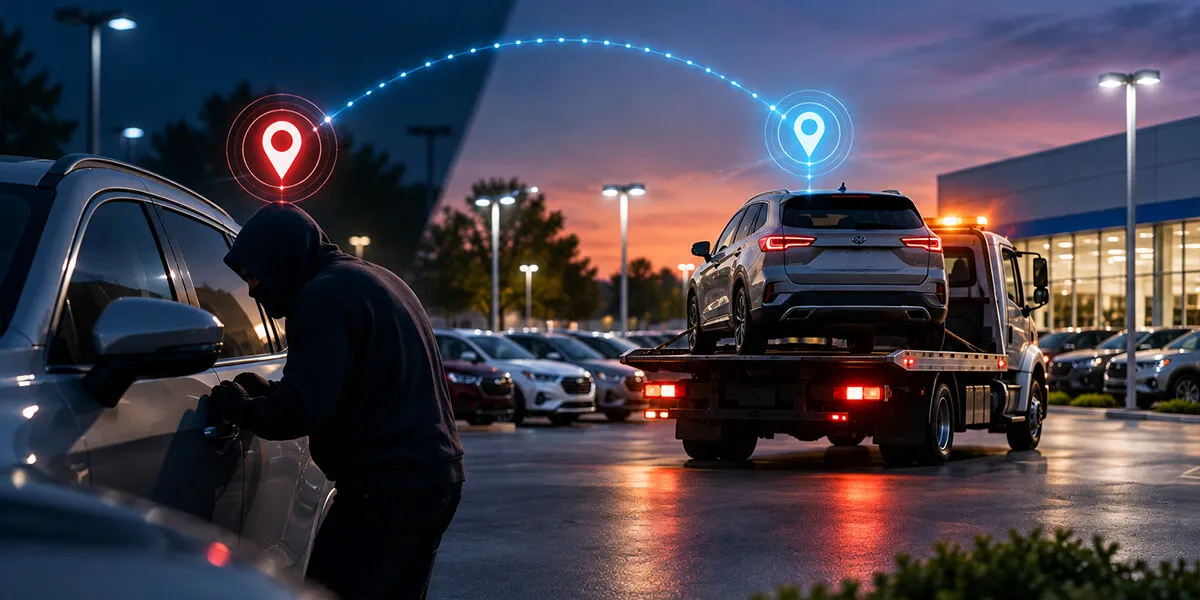
GPS Theft Recovery for Car Dealerships | AVAS Automotive Data Platform
GPS Theft Recovery for Car Dealerships: Protecting New and Used Vehicle Inventory
Vehicle theft is not simply a consumer problem.
For new and used car dealerships, every vehicle sitting on the lot represents a high-value asset that can be exposed to theft, unauthorized movement, fraudulent test drives, key-related theft, or other security risks.
Even as vehicle theft has declined from its recent peak, the scale remains significant.
The National Insurance Crime Bureau reported 659,880 vehicle thefts in 2025, a 23.2% decline from 850,708 thefts in 2024. That represents 190,828 fewer reported thefts in a single year, but still more than 659,000 stolen vehicles nationwide.
For dealerships managing hundreds—or dealer groups managing thousands—of vehicles, the lesson is straightforward:
Lower national theft numbers do not eliminate dealership risk.
Dealerships still need multiple layers of vehicle security.
Key Controls
↓
Cameras & Lighting
↓
Physical Access Controls
↓
Employee Procedures
↓
GPS & Geofencing
↓
Theft Detection
↓
Recovery Procedures
↓
Law-Enforcement Coordination
GPS should not replace the other layers.
Instead, it adds something many traditional security measures cannot provide once a vehicle leaves dealership property:
continued vehicle-location visibility.
That is where GPS theft recovery for car dealerships becomes particularly valuable.
And with AVAS, the same connected vehicle technology initially deployed to help protect dealership inventory can potentially transition into a customer-facing theft protection and connected ownership experience after the vehicle is sold.
The strategy becomes:
Protect the vehicle before sale.
↓
Protect the customer after sale.
↓
Maintain the dealership relationship throughout ownership.
↓
Transform authorized vehicle information into intelligence through the AVAS Automotive Data Platform.
That is a much larger opportunity than simply installing a GPS tracker in dealership inventory.
What Is GPS Theft Recovery for Car Dealerships?
GPS theft recovery for car dealerships uses connected GPS technology to provide authorized vehicle-location information that can assist a dealership when an equipped vehicle is missing or reported stolen.
The distinction between theft prevention and theft recovery is important.
GPS does not physically prevent someone from stealing a vehicle.
Instead, depending on device capabilities, connectivity, and configuration, GPS can potentially provide information such as:
Current or last reported vehicle location
Vehicle movement
Geofence activity
Location history
Time of movement
Device status
Other configured vehicle events
That information can help dealership personnel determine what happened and support an organized recovery response.
Consider a traditional security camera.
A camera may show:
The vehicle left the dealership at 2:14 a.m.
That information can be extremely valuable.
But once the vehicle leaves camera coverage, the camera generally cannot tell the dealership where it went.
GPS adds another potential question:
Where is the equipped vehicle reporting now?
That distinction is central to GPS-assisted vehicle recovery.
For a broader explanation of how dealerships can use GPS across inventory management, lot operations, demos, loaners, connected ownership, and customer intelligence, see our complete guide to GPS tracking for car dealerships.
Dealership Vehicle Theft Protection Requires Multiple Layers
No dealership should treat a GPS device as its complete security strategy.
Vehicle security works best as a layered system.
NHTSA recommends common theft-prevention measures such as removing keys from vehicles, locking doors and windows, parking in well-lit areas, and using anti-theft technologies. NHTSA specifically identifies vehicle-recovery systems as technology that can use electronic transmission to help law enforcement identify the location of stolen vehicles. NHTSA provides additional vehicle theft prevention and recovery guidance here.
For dealerships, that layered strategy may include:
Key Management
Control who can access vehicle keys and establish accountability around key usage.
Cameras
Provide surveillance around inventory areas, entrances, exits, buildings, and other strategic locations.
Lighting
Improve nighttime visibility and reduce poorly observed areas of dealership property.
Physical Access Controls
Control appropriate access to dealership lots, buildings, inventory areas, and keys.
Employee Procedures
Establish clear policies for test drives, demos, loaners, dealer trades, after-hours access, vehicle transfers, and suspicious activity.
Insurance
Maintain appropriate coverage and follow insurer requirements for vehicle security and loss reporting.
GPS
Provide another source of connected vehicle-location information when an equipped vehicle moves or leaves dealership property.
These systems answer different questions.
A camera can help answer:
What happened here?
A key-management system can help answer:
Who accessed the key?
An access-control system can help answer:
Who entered the area?
GPS can help answer:
Where did the equipped vehicle go?
When those systems work together, dealership management has more context.
Why Dealership Inventory Creates a Unique Security Challenge
A dealership is not a warehouse where every asset is expected to remain stationary.
Vehicles are supposed to move.
Throughout a normal day, dealership inventory may:
Move between parking areas
Enter service
Leave for fuel
Go on test drives
Visit off-site vendors
Transfer between rooftops
Leave for dealer trades
Move through reconditioning
Be assigned as demos
Operate as loaners
Be staged for customer delivery
That creates a difficult security problem:
Vehicle movement alone is not necessarily suspicious.
A GPS platform that treats every movement as a potential theft could create unnecessary alert volume.
The more valuable objective is identifying activity that is unusual given the vehicle's expected operational role.
Consider:
Retail inventory leaves at 2:00 p.m. for a documented test drive.
Likely normal.
Loaner leaves with an authorized customer.
Expected.
Demo leaves with its assigned driver.
Expected.
But:
Unassigned retail inventory exits dealership property at 2:00 a.m.
Potential exception.
That is why effective dealership GPS security should focus on context and exception management rather than simply monitoring movement.
After-Hours Unauthorized Vehicle Movement
One of the clearest dealership security use cases involves unexpected movement after business hours.
Imagine a new SUV parked on the dealership lot at closing.
At 2:17 a.m., the vehicle begins moving.
At 2:21 a.m., it leaves the dealership property.
Without connected vehicle technology, the dealership might not discover the missing inventory until employees arrive the following morning.
Depending on GPS hardware and platform configuration, movement and geofence information can potentially help identify the unexpected activity sooner.
The workflow could become:
Vehicle Stationary on Dealership Lot
↓
Unexpected After-Hours Movement
↓
Vehicle Exits Defined Area
↓
Exception Identified
↓
Authorized Personnel Review
↓
Determine Whether Movement Is Legitimate
↓
If Theft Is Confirmed → Activate Dealership Recovery Procedure
The objective should not be to automatically label every unexpected movement as theft.
There may be legitimate reasons for unusual activity.
The objective is to reduce the time between:
Unexpected Event
and:
Human Awareness
That can be particularly important when a vehicle is ultimately determined to be stolen.
GPS Geofence Alerts for Car Dealerships
A geofence is a virtual geographic boundary established around a physical location.
For dealership security, geofences may be useful around:
Main dealership property
New-vehicle storage
Used-vehicle lots
Overflow inventory
Reconditioning centers
Off-site storage
Collision facilities
Other dealership rooftops
Depending on system configuration, an equipped vehicle entering or leaving one of those areas can create a relevant event.
But geofencing becomes more valuable when combined with operational context.
Consider:
Vehicle exits the main dealership at 11:00 a.m.
That may simply be a test drive.
The same vehicle exits at:
3:00 a.m.
That may warrant immediate review.
Similarly:
Vehicle leaves Store A and arrives at Store B during an approved transfer.
Expected.
But:
Vehicle assigned to Store A appears miles away overnight without an approved transfer.
Potential exception.
The intelligence does not come from the geofence alone.
It comes from comparing physical vehicle activity with the dealership's expected workflow.
Manage Dealership Security by Exception
A dealership with 500 connected vehicles does not need 500 streams of location data demanding employee attention.
A dealer group with 10,000 connected vehicles certainly does not.
The system should help dealership personnel focus on exceptions.
For example:
10,000 Connected Vehicles
↓
9,980 Behaving as Expected
↓
20 Potential Exceptions
↓
Prioritize Exceptions
↓
Human Review
This creates a more scalable security model.
Instead of:
Watch every vehicle
the dealership can move toward:
Identify vehicles requiring attention.
This is also where AI can eventually play an important role.
As connected vehicle populations grow, intelligent systems can help identify unusual patterns, prioritize events, and reduce the amount of raw information employees must manually interpret.
Use Case: Overnight Dealership Vehicle Theft
Consider a hypothetical dealership carrying 350 vehicles.
At closing, inventory appears normal.
At 1:48 a.m., one equipped vehicle unexpectedly moves.
At 1:52 a.m., it exits the dealership geofence.
The activity is inconsistent with the expected behavior for that inventory vehicle.
An authorized dealership employee reviews the information.
The dealership verifies there is no:
Approved vehicle transfer
Employee authorization
Service activity
Dealer trade
Demo assignment
Other legitimate explanation
The dealership determines the vehicle may have been stolen and activates its established response procedure.
The potential advantage is not that GPS physically prevented the theft.
It is that connected vehicle technology can provide information that helps the dealership recognize the event and potentially maintain location context after the vehicle leaves dealership property.
That changes the information available during the response.
Speed and Process Matter When a Vehicle Is Stolen
When a dealership determines that a vehicle is stolen, employees should not personally pursue the vehicle or confront suspected thieves.
The response should prioritize safety and proper law-enforcement coordination.
NHTSA advises vehicle-theft victims to contact police immediately and notes that law enforcement may request information including the license plate, make, model, color, VIN, and identifying characteristics. NHTSA also advises contacting the insurance company promptly.
For a dealership using GPS, an established recovery workflow can organize additional information that may be available from the connected vehicle.
That might include:
VIN
Stock Number
Year / Make / Model
License Plate, if applicable
Last Known Dealership Location
Time Unexpected Movement Began
Last Reported GPS Location
Relevant Location History
Other Appropriate Vehicle Information
The objective is to make relevant information quickly available to authorized personnel while keeping dealership employees out of potentially dangerous recovery situations.
GPS Should Support Law Enforcement—Not Replace It
A GPS location is information.
It is not authorization for dealership employees to retrieve a stolen vehicle themselves.
A structured recovery process might look like:
Confirm Vehicle Is Missing
↓
Review Internal Records
↓
Verify Movement Was Not Authorized
↓
Follow Dealership Theft Procedures
↓
Notify Law Enforcement
↓
Provide Vehicle Identification Information
↓
Provide Appropriate GPS Information
↓
Maintain Authorized Monitoring
↓
Coordinate Through Proper Channels
Dealership procedures should clearly establish:
Who is authorized to access GPS information?
Who communicates with law enforcement?
Who contacts the insurer?
Who documents the event internally?
Who handles the recovery process after law enforcement locates the vehicle?
Those questions are much easier to answer before a theft occurs than during one.
Vehicle Location History Can Help Reconstruct a Theft Event
The current location of a stolen vehicle is often the most urgent question.
But historical location information, where supported and appropriately available, may provide additional context.
Suppose dealership employees discover a vehicle missing at 8:00 a.m.
Location history could potentially help determine:
When did the vehicle leave?
Which direction did it travel?
Did it stop somewhere?
Did it move again?
What was its last reported location?
This can help establish a timeline.
Security cameras may provide evidence of what happened on dealership property.
Access logs may show relevant activity.
Key-management records may provide additional information.
GPS history can potentially add the vehicle's subsequent movement.
That creates a broader incident picture:
Camera Information
Access Information
Key Records
GPS Location History
↓
Better Event Context
Again, GPS does not replace the other security systems.
Its value comes partly from filling the physical-location gap after the vehicle leaves the dealership.
Stolen Dealership Inventory Is Not Limited to Overnight Theft
Not every dealership vehicle disappears from a lot at night.
Risk can occur during normal dealership operations.
A vehicle may become exposed during:
Test drives
Delivery staging
Dealer trades
Transportation
Off-site service
Reconditioning
Demo assignments
Loaner use
Vehicle transfers
Other legitimate movements
This creates an important distinction between property security and vehicle security.
Dealership cameras, lighting, gates, and access controls are centered around locations.
GPS travels with the equipped vehicle.
That means the connected security layer can potentially continue beyond the physical boundaries of the dealership.
Test-Drive Theft Requires a Different GPS Strategy
Test drives are intentionally authorized.
The customer is supposed to leave dealership property with the vehicle.
That means a geofence departure alone cannot indicate theft.
The dealership needs additional context.
Questions might include:
How long has the vehicle been away?
Has the agreed test-drive period been substantially exceeded?
Can the dealership reach the driver?
Has the dealership determined that the vehicle was not returned as agreed?
Has law enforcement been contacted when appropriate?
If the dealership ultimately determines the vehicle has been stolen, GPS may provide additional location information to support the response.
But GPS should complement—not replace—good test-drive procedures.
Those procedures may include:
Driver identification
Appropriate documentation
Key controls
Test-drive policies
Employee procedures
Insurance requirements
Escalation procedures
GPS adds another security layer.
It should not become a reason to weaken the others.
Demo Vehicles Require Context-Aware Security
Demo vehicles present another challenge.
A demo may legitimately spend evenings and weekends away from dealership property.
A traditional geofence strategy that generates an alert every time the vehicle leaves the dealership could therefore create unnecessary noise.
The GPS strategy should account for the operational role of the vehicle.
Retail Inventory
Expected primarily at dealership-controlled locations.
Demo
Expected to travel with an authorized driver.
Loaner
Expected to operate away from the dealership.
Dealer Trade
Expected to travel between approved locations.
Off-Site Inventory
Expected at an authorized vendor or storage location.
The question is not:
"Did the vehicle move?"
It is:
"Does this movement make sense for this vehicle?"
That is a much more useful security question.
Loaner Vehicles Create Another Theft-Recovery Use Case
Service loaners routinely leave dealership property.
That makes them fundamentally different from front-line inventory.
A loaner may remain with a customer overnight or for multiple days depending on dealership policy and the underlying service situation.
GPS can potentially provide another layer of authorized asset visibility if:
The vehicle becomes overdue
The dealership cannot establish its location
The customer cannot be reached
The vehicle is not returned as agreed
The vehicle is ultimately reported stolen
Recovery assistance becomes necessary
The dealership's loaner agreement, communication process, insurance requirements, privacy obligations, and escalation procedures remain essential.
GPS supplements those processes with physical vehicle information.
Off-Site Inventory Needs Security Visibility Too
Vehicles often leave the dealership for legitimate business reasons.
An inventory vehicle might be sent to:
Body repair
Paintless dent repair
Wheel repair
Window tint
Upholstery
Accessory installation
Reconditioning
Detail
Storage
Photography
Transportation
The dealership still owns the asset even though it is no longer physically on dealership property.
That creates a security visibility gap.
GPS can help answer:
Did the vehicle reach the expected facility?
Is it still reporting from that area?
Has it unexpectedly moved?
Has it returned to dealership property?
This is different from the operational inventory-management use case covered in our Dealership GPS Inventory Tracking article.
Dealer Trades and Vehicle Transfers Need Verification
Dealer trades create another legitimate reason for inventory to leave dealership property.
The dealership may authorize:
Store A
↓
Transfer
↓
Store B
GPS can contribute another source of physical verification during that process.
For example:
Vehicle remains at Store A
Transfer may not have begun.
Vehicle is moving between locations
Transfer appears underway.
Vehicle arrives at Store B
Physical movement aligns with the expected transfer.
But if the vehicle deviates substantially from the expected process, the location information may warrant review.
Again, GPS does not determine whether a vehicle has been stolen.
It helps the dealership understand whether physical vehicle behavior aligns with authorized activity.
Multi-Rooftop Dealer Groups Need Centralized Security Visibility
The security challenge becomes more complex as dealer groups grow.
A single dealership may have:
400 connected vehicles.
A large group may have:
4,000, 10,000, or more.
Those vehicles may be distributed across:
Franchise rooftops
Used-car operations
Storage lots
Service facilities
Reconditioning centers
Collision centers
Corporate fleets
Demo populations
Loaner fleets
A fragmented security model forces each location to operate independently.
A centralized connected vehicle strategy can provide authorized group-level visibility.
The structure might look like:
Dealer Group
↓
Region
↓
Rooftop
↓
Vehicle Population
↓
Individual Vehicle
Permissions can then be aligned with responsibility.
A salesperson may need access to appropriate local inventory.
A general manager may need rooftop-level visibility.
A corporate security or operations leader may need broader group-level visibility.
That creates a scalable security architecture rather than giving every employee access to every connected vehicle.
GPS Can Help Create a Standardized Dealership Theft-Recovery Workflow
Technology becomes more valuable when it supports a repeatable process.
Dealerships implementing GPS should consider documenting a standard theft-response procedure.
For example:
Step 1: Verify the Vehicle
Confirm the VIN, stock number, make, model, and relevant inventory information.
Step 2: Verify Authorization
Determine whether the vehicle is:
On a test drive
Assigned as a demo
Being used as a loaner
At service
At an off-site vendor
In transit
Involved in a dealer trade
Being used by an authorized employee
Step 3: Review Available Security Information
Review appropriate:
GPS information
Camera footage
Key records
Access records
Employee information
Transaction records
Step 4: Escalate Internally
Notify the appropriate dealership manager or designated security contact.
Step 5: Contact Law Enforcement
If the vehicle is determined to be stolen, follow the dealership's established reporting procedure.
Step 6: Provide Relevant Vehicle Information
Provide the appropriate VIN, description, license information, GPS information, and other requested documentation.
Step 7: Maintain Authorized GPS Visibility
Continue providing relevant location information through approved channels where appropriate.
Step 8: Notify the Insurer
Follow applicable insurance reporting requirements.
Step 9: Document the Incident
Record the event and outcome for internal review.
Step 10: Review the Security Process
Determine whether policies, access controls, alerts, or other procedures should change.
This turns GPS from a passive map into part of an operational recovery system.
Recovery Data Can Improve Future Dealership Security
Every significant security incident creates an opportunity to improve the dealership's procedures.
After an incident, management can ask:
How was the theft discovered?
How much time passed before discovery?
Was an alert generated?
Did the right employee receive it?
Was the vehicle correctly associated with the GPS device?
Were GPS credentials immediately accessible?
Was law enforcement given the required information quickly?
Did employees know the escalation process?
Were there unnecessary delays?
What should change?
This creates a continuous improvement loop:
Security Event
↓
Response
↓
Recovery Outcome
↓
Post-Incident Review
↓
Process Improvement
↓
Better Future Response
That is far more sophisticated than simply installing GPS devices and assuming the dealership is protected.
GPS Theft Recovery Should Begin Before a Vehicle Is Stolen
The worst time to design a recovery workflow is after discovering a $50,000 vehicle missing from the lot.
The dealership should establish the process in advance.
That includes ensuring:
GPS devices are correctly associated with vehicles
Authorized users have appropriate access
Employee contact information is current
Escalation responsibilities are documented
Geofences are properly configured
Relevant alerts are tested
Theft-response procedures are documented
Employees understand that they should not attempt unsafe recoveries
Law-enforcement coordination procedures are understood
The technology should be ready before the event occurs.
So should the people.
AVAS GPS Adds a Connected Recovery Layer
This is where AVAS begins to differentiate the dealership security strategy.
AVAS GPS can provide the connected vehicle layer that supports authorized vehicle visibility and appropriate recovery workflows.
The basic model is:
Dealership Vehicle
↓
AVAS GPS
↓
Connected Vehicle Visibility
↓
Movement / Location Context
↓
Potential Exception
↓
Dealership Review
↓
Recovery Workflow When Necessary
That provides value while the vehicle remains dealership inventory.
But unlike a security strategy that ends when the dealership sells the vehicle, the AVAS opportunity can continue.
The connected relationship can potentially transition from:
Dealership Asset Protection
to:
Customer Vehicle Protection
That creates an entirely different lifecycle for the technology.
Protect the Vehicle Before Sale. Protect the Customer After Sale.
The dealership initially installs GPS because it wants greater visibility into its inventory.
The vehicle is eventually sold.
At that point, there are two possible models.
Traditional Inventory Security Model
Install Technology
↓
Protect Dealership Asset
↓
Vehicle Sold
↓
Dealership Use Case Ends
AVAS Connected Ownership Model
Install AVAS GPS
↓
Help Protect Dealership Inventory
↓
Vehicle Sold
↓
Transition to Customer-Facing Protection
↓
Maintain Connected Ownership Relationship
↓
Create Ongoing Customer Value
↓
Develop Authorized Vehicle Intelligence
↓
Connect With the AVAS Automotive Data Platform
The vehicle connection does not have to lose its value simply because the dealership is no longer the vehicle owner.
Instead, its purpose changes.
GPS Theft Recovery for Car Dealerships: Protecting New and Used Vehicle Inventory
Dealership Theft Protection Can Become Customer Theft Protection
The dealership's need to protect a vehicle does not disappear when the vehicle is sold.
The person who needs protection simply changes.
Before the sale, the dealership has a financial interest in protecting its inventory.
After the sale, the customer has a financial and personal interest in protecting the vehicle they just purchased.
That creates a natural transition for GPS technology:
Dealership Inventory
↓
AVAS GPS Protection
↓
Vehicle Sale
↓
Customer Enrollment
↓
Consumer Vehicle Protection
↓
Connected Ownership
Instead of treating GPS as temporary inventory technology, a dealership can potentially transition the connected vehicle relationship into a customer-facing theft protection program.
This creates value on both sides of the transaction.
The dealership receives connected vehicle visibility while it owns the asset.
The customer can receive appropriate connected vehicle and theft-protection functionality after taking ownership.
For AVAS, that transition is central to the strategy:
Protect the dealership's vehicle before sale.
Help protect the customer's vehicle after sale.
Maintain a valuable dealership relationship throughout ownership.
Vehicle Theft Remains Relevant After the Customer Drives Away
A customer may not spend much time thinking about vehicle theft while sitting in the dealership's finance office.
But the risk becomes theirs as soon as they take ownership.
According to the National Highway Traffic Safety Administration's vehicle theft prevention guidance, more than 650,000 vehicles were stolen nationwide in 2025—approximately one vehicle every 48 seconds.
That creates an opportunity for dealerships to offer something customers can easily understand:
technology designed to help protect the vehicle they are purchasing.
The value proposition is fundamentally different from many abstract technology products.
Customers understand the question:
"What happens if my vehicle is stolen?"
A connected theft-protection program can provide a meaningful answer.
From Dealership GPS to a Customer-Facing Theft Protection Product
The customer should not feel as though the dealership simply left its inventory tracker in their vehicle.
The post-sale experience should be intentionally designed around the customer.
That means transitioning from:
Dealer Inventory Technology
to:
Consumer Connected Vehicle Technology
Depending on the specific product configuration, a customer-facing experience can potentially include appropriate functionality related to:
Vehicle location
Theft-recovery assistance
Connected vehicle information
Customer support
Vehicle protection
Ownership engagement
Other connected services
The key is that the customer's experience should have a clear purpose and value.
This also gives the dealership an opportunity to differentiate the ownership experience.
Instead of the relationship ending with:
"Thank you for your purchase."
the dealership can begin another phase:
"We're still connected to help support your ownership experience."
Use Case: The Customer's Vehicle Is Stolen
Consider a customer who purchased a vehicle from the dealership several months earlier.
The customer walks outside one morning and discovers the vehicle is gone.
Without a connected vehicle program, the process may begin with:
Vehicle Missing
↓
Police Report
↓
Insurance Claim
↓
Wait
With an appropriate connected theft-recovery program, there may be another source of information available:
Vehicle Missing
↓
Customer Reports Theft
↓
Law Enforcement Notified
↓
Authorized Recovery Process Activated
↓
Available Vehicle Location Information Reviewed
↓
Appropriate Information Provided for Recovery Coordination
↓
Recovery Process Continues
The GPS technology does not replace police.
It does not replace insurance.
And it does not guarantee recovery.
It adds a connected vehicle information layer that can potentially assist the established recovery process.
That distinction is important both operationally and when communicating the product to customers.
The Dealership Can Remain Part of the Ownership Experience
One of the challenges automotive retailers face is maintaining a meaningful relationship after the sale.
During the purchase process, the dealership may interact with the customer repeatedly.
Then the vehicle is delivered.
Communication can become sporadic.
The customer may not return until:
Service is required
or:
Another vehicle is needed.
Connected ownership creates another model.
The dealership can remain relevant by providing ongoing value associated with the customer's vehicle.
That value can include protection, useful vehicle information, ownership services, appropriate communications, and other connected experiences.
This concept connects directly with automotive digital retail and connected ownership.
Digital retail should not necessarily end at checkout.
The connected ownership experience can continue throughout the customer's relationship with the vehicle.
Theft Protection Can Strengthen the Connected Ownership Value Proposition
Many dealership products provide value only if something goes wrong.
Connected technology can potentially create a more persistent relationship.
The customer may initially value the program because of:
Vehicle Theft Protection
But the broader ownership relationship can potentially include:
Vehicle Protection
↓
Connected Ownership
↓
Useful Vehicle Information
↓
Dealership Engagement
↓
Service Relationship
↓
Future Vehicle Relationship
That makes the connected vehicle more strategically important.
The theft-protection benefit can be the reason the customer understands the product.
The connected relationship can be what allows the dealership to create additional value over time.
GPS Theft Recovery Can Support Customer Retention
Customer retention is often discussed primarily in terms of service.
But retention begins with maintaining relevance.
A dealership that provides useful technology after delivery has another opportunity to remain part of the customer's ownership experience.
That does not mean overwhelming the customer with marketing messages.
In fact, excessive communication can undermine the value of the relationship.
The better strategy is:
Provide Value
↓
Maintain Connection
↓
Understand Ownership
↓
Engage When Relevant
↓
Create Opportunity
This connects naturally with dealership customer retention and lifecycle marketing.
The strategic point is that theft protection can become more than a standalone product.
It can become an entry point into a longer customer lifecycle.
The Connected Vehicle Can Create Authorized Vehicle Intelligence
A GPS device creates a connection to the vehicle.
Depending on hardware capabilities, program configuration, customer permissions, and applicable requirements, that connection may support more than location information.
Authorized vehicle information can potentially contribute context such as:
Mileage
Vehicle activity
Vehicle status
Relevant device events
Other supported vehicle information
That leads into the larger concept of connected vehicle intelligence for dealerships.
The distinction is important.
GPS Tracking
primarily answers:
Where is the vehicle?
Connected vehicle intelligence can help contribute toward:
What is happening with the vehicle?
The dealership's broader customer data can then help answer:
Why does that matter?
Theft Protection Creates a Vehicle Connection—Not Permission to Use Everything
The existence of a connected vehicle does not mean every available piece of information should automatically be used for every possible business purpose.
Dealerships should maintain clear policies around:
Customer notice
Consent where required
Permitted uses
User access
Data security
Data retention
Customer privacy rights
Internal governance
Appropriate data sharing
Those principles are especially relevant when vehicle technology transitions from dealership-owned inventory to a customer-owned vehicle.
The program should clearly distinguish:
Dealership Asset
from:
Customer Vehicle
and:
Inventory Security Use
from:
Customer-Authorized Connected Services.
Responsible data use is not separate from the product strategy.
It is part of building a connected vehicle program customers and dealerships can trust.
Customer Access and Dealership Access Should Be Purpose-Driven
A connected ownership program should also consider who can access which information.
During the inventory stage, authorized dealership employees may require location information for legitimate dealership operations.
After the sale, access requirements change.
The dealership should not assume that every employee who could locate an inventory vehicle should continue having the same access after the vehicle becomes customer-owned.
A scalable platform should support appropriate separation.
Conceptually:
Inventory Vehicle
→ Appropriate dealership operational access.
Customer-Owned Vehicle
→ Customer-facing functionality plus only appropriate authorized dealership access for defined purposes.
This is particularly important for large dealer groups.
Technology should make access easier to control—not harder.
AI Can Help Identify Security Exceptions Across Large Vehicle Populations
Connected vehicle security becomes a data-management problem at scale.
Consider a dealer group with:
8,000 connected vehicles.
Even if each vehicle generates only a modest amount of information, manually reviewing the entire population would be impractical.
The dealership does not need more noise.
It needs prioritization.
This is where AI for automotive dealerships can potentially add value.
Instead of displaying thousands of normal events, AI can help identify activity that deserves attention.
For example:
8,000 Connected Vehicles
↓
Normal Vehicle Activity
↓
Potential Exceptions Identified
↓
Exceptions Prioritized
↓
Authorized Employee Review
The objective is not for AI to declare that a vehicle has been stolen.
That determination requires context.
The objective is to help surface activity that may warrant human review.
AI Can Add Context to Vehicle Movement
Consider the difference between simple GPS logic and contextual intelligence.
A basic rule might say:
Vehicle left geofence = alert.
But dealerships have vehicles leaving geofences constantly.
An intelligent system can potentially evaluate additional context.
For example:
Vehicle Type: Retail inventory
Time: 2:37 a.m.
Expected Location: Dealership
Movement: Vehicle departed property
Approved Transfer: None identified
That combination may deserve higher priority.
Compare it with:
Vehicle Type: Loaner
Time: 2:37 p.m.
Expected Location: Off-site with customer
Movement: Normal
Those are two very different situations even though both vehicles are outside the dealership geofence.
This illustrates the future of connected vehicle security:
Data + Context + AI = Better Prioritization
Use Case: Multi-Rooftop Security Command View
Consider a dealer group operating 15 rooftops.
Each store may have:
New inventory
Used inventory
Demos
Loaners
Overflow lots
Off-site vehicles
Instead of requiring corporate management to log into each rooftop independently, a centralized security view could organize connected vehicles by:
Dealer Group
↓
Region
↓
Rooftop
↓
Vehicle Population
↓
Security Exception
Management could potentially see:
Store A — Normal
Store B — 2 exceptions requiring review
Store C — Normal
Store D — 1 unexpected after-hours movement
The exact functionality depends on system configuration, but the management principle is important.
Executives do not need more maps.
They need:
visibility into what requires attention.
Security Intelligence Can Become Business Intelligence
Once security events are structured, dealerships can begin measuring them.
Leadership may want to understand:
Number of connected inventory vehicles
Number of relevant movement exceptions
After-hours events
Geofence exceptions
Reported theft incidents
Recovery events
Recovery outcomes
Average response time
Device connectivity
Location availability during incidents
Customer theft-recovery events
Multi-rooftop trends
This creates an opportunity to move from individual incidents toward automotive business intelligence.
The executive question changes from:
"What happened to this vehicle?"
to:
"What can our security and connected vehicle data tell us about the organization?"
That is a much more strategic use of information.
Measure the GPS Theft-Recovery Program
A dealership should establish meaningful KPIs for its connected security program.
Possible measures include:
Connected Inventory Coverage
What percentage of eligible inventory has an active connected device?
Device Health
What percentage of expected devices are communicating properly?
Exception Volume
How many security-related exceptions require human review?
False-Positive Rate
How many alerts turn out to represent normal dealership activity?
A high false-positive rate can lead to alert fatigue.
Detection Time
How long does it take the dealership to become aware of a potentially unauthorized movement?
Escalation Time
How quickly does the event reach the appropriate employee?
Recovery Support
When a theft occurs, was usable location information available?
Recovery Outcome
What ultimately happened to the stolen vehicle?
Customer Enrollment
How many eligible customers transition into the post-sale connected vehicle program?
The last KPI connects security directly with the larger AVAS business strategy.
The Business Case Extends Beyond Preventing a Loss
Dealership executives naturally think about theft in financial terms.
If a high-value inventory vehicle is stolen, the dealership can face:
Asset loss
Insurance involvement
Employee time
Administrative work
Operational disruption
Potential vehicle damage
Recovery expenses
Customer disruption
Other indirect costs
GPS-assisted recovery may help reduce certain risks, but the AVAS business case can extend further.
The same installed technology can potentially produce value across:
Inventory Security
Vehicle Recovery
Customer Product Value
Connected Ownership
Customer Engagement
Vehicle Intelligence
Service Opportunities
Retention
Future Sales Opportunities
This changes the economics of the technology.
Instead of asking:
"How much does GPS security cost per vehicle?"
the dealership can ask:
"How much value can one connected vehicle relationship create?"
The Customer-Facing Program Can Create a New Value Proposition
When positioned appropriately and supported by applicable disclosures and processes, connected vehicle protection can become a dealership value-added product.
The customer receives a benefit that is easy to understand:
Help protect my vehicle and support recovery if it is stolen.
The dealership receives an opportunity to:
Differentiate the ownership experience
Extend the connected customer relationship
Create customer-facing product value
Maintain engagement after delivery
Build a larger connected vehicle population
This is especially important because the technology can serve two distinct economic purposes.
Before Sale
The dealership receives operational and security value.
After Sale
The customer receives connected vehicle value, while the dealership can maintain an appropriate ongoing relationship.
One technology investment can therefore participate in multiple stages of the vehicle lifecycle.
The Vehicle Connection Can Eventually Support Service Opportunities
The connection established for theft protection can potentially become relevant to other dealership departments.
Consider mileage.
Where mileage information is supported, appropriately authorized, and available, it can provide additional context for the service department.
Traditional service marketing may rely heavily on:
Time Since Last Service
But customers drive very different amounts.
One customer may drive:
5,000 miles per year.
Another:
25,000 miles per year.
The calendar treats them similarly.
Vehicle usage does not.
When appropriate connected vehicle information is combined with service history, the dealership may gain better context.
For example:
Last Known Service Mileage
Current Authorized Mileage
Repair Order History
↓
Potential Service Opportunity
The GPS theft-protection relationship has now contributed to something much broader than theft recovery.
Connected Ownership Can Help Identify Retention Opportunities
The same principle can apply to customer retention.
Suppose a customer has accumulated significant mileage since their last dealership repair order.
That does not prove they are servicing elsewhere.
But it may create a useful signal.
For example:
Connected Vehicle Indicates Significant Mileage
No Recent Dealership RO
↓
Potential Service-Defection Signal
↓
Customer Opportunity
↓
Relevant Engagement
The dealership is moving from:
mass communication
toward:
event- and lifecycle-driven engagement.
That is one of the larger strategic opportunities behind connected ownership.
The Theft-Protection Relationship Can Eventually Support the Next Vehicle Sale
Vehicle ownership eventually leads to another purchase decision.
A dealership that remains connected throughout ownership can potentially understand that lifecycle better.
Relevant signals may include:
Ownership Duration
Mileage
Service History
Customer Engagement
Vehicle Information
Equity Information Where Available
↓
Potential Replacement-Cycle Opportunity
This is where predictive analytics for dealerships becomes relevant.
GPS alone does not predict who will buy another vehicle.
But authorized connected vehicle information can become one signal among many.
The intelligence comes from combining signals.
From Theft Recovery to First-Party Data
The dealership already possesses valuable first-party information through its direct customer relationships.
That can include:
Customer identity
Contact information
Vehicle purchased
Transaction history
Service history
Trade history
Marketing engagement
Ownership information
Connected vehicle technology can potentially add another dimension.
That makes the GPS relationship relevant to first-party data for dealerships.
The progression becomes:
Customer
Vehicle
Ownership
Service
Engagement
Authorized Connected Vehicle Intelligence
↓
Richer First-Party Customer Understanding
This is where AVAS begins moving from a GPS security solution into a dealership data strategy.
AVAS Connects Vehicle Protection With Customer Intelligence
The AVAS opportunity can now be viewed across two major phases.
Phase 1: Dealership-Owned Vehicle
AVAS GPS can support:
Vehicle Visibility
Geofencing
Movement Context
Security Exceptions
Theft-Recovery Workflows
Multi-Rooftop Visibility
Then the vehicle sells.
Phase 2: Customer-Owned Vehicle
The relationship can potentially transition into:
Customer Vehicle Protection
Theft-Recovery Support
Connected Ownership
Customer Engagement
Authorized Vehicle Intelligence
Lifecycle Opportunities
The connected vehicle becomes a bridge between dealership operations and customer ownership.
The AVAS Automotive Data Platform Expands the Value of the Connection
The final step is bringing appropriate vehicle intelligence together with the dealership's broader customer information.
Conceptually:
AVAS GPS
↓
Vehicle Protection
↓
Connected Ownership
↓
Authorized Vehicle Intelligence
Customer Data
Service Data
Transaction Data
Engagement Data
↓
AVAS Automotive Data Platform
↓
AI + Predictive Analytics
↓
Relevant Dealership Opportunities
That is the strategic AVAS difference.
The technology initially installed to answer:
"Where is our stolen vehicle?"
can become part of a platform capable of helping the dealership ask:
"What should we know about this customer and vehicle relationship?"
and ultimately:
"What should we do next?"
GPS Theft Recovery for Car Dealerships: Protecting New and Used Vehicle Inventory
What Should Dealers Look for in a GPS Theft-Recovery Solution?
A dealership evaluating GPS theft recovery should look beyond whether a device can place a vehicle on a map.
Location is essential, but a dealership security program depends on the entire system surrounding that location data.
A solution designed for automotive retailers should be evaluated across areas such as:
Hardware reliability
Cellular connectivity
GPS/GNSS performance
Movement detection
Geofencing
Configurable reporting
Location history
Recovery capabilities
Device health
Remote configuration
User permissions
Multi-rooftop administration
APIs and integrations
Data security
Customer transition
Scalability
Support
Most importantly, dealers should evaluate the technology across the entire vehicle lifecycle.
The question should not simply be:
"Can this help us locate a stolen inventory vehicle?"
It should also be:
"What happens to this technology after we sell the vehicle?"
That second question is where AVAS creates a larger opportunity.
Reliable Hardware Is the Foundation of GPS Theft Recovery
A recovery platform is only useful when the underlying connected vehicle technology is functioning as expected.
Dealers should therefore consider hardware reliability as part of the buying decision.
That includes evaluating:
Cellular Connectivity
The device needs appropriate network connectivity to communicate location information.
GPS/GNSS Performance
The hardware needs reliable positioning capabilities appropriate for the intended application.
Power Management
Dealership inventory can remain stationary for extended periods, so the device's power behavior should match the deployment strategy.
Movement Detection
Movement information can help distinguish a stationary inventory vehicle from one that has begun moving.
Device Health
Administrators should be able to identify devices that are not communicating as expected.
Installation Quality
A poorly installed or incorrectly provisioned device can undermine the entire program.
A dealer group deploying thousands of devices needs more than reliable hardware.
It needs a reliable deployment process.
Remote Device Management Matters at Scale
Imagine discovering during a security event that a GPS device has not communicated properly for weeks.
That is why device health should be managed proactively rather than discovered during an emergency.
A scalable connected vehicle program should provide administrators with appropriate visibility into device status and, where supported, capabilities such as:
Remote configuration
Reporting-profile management
Device diagnostics
Connectivity monitoring
Firmware management
OTA updates
Device grouping
Operational settings
This becomes increasingly important as a dealership expands from:
100 connected vehicles
to:
1,000
to:
10,000+
Manually managing every device becomes increasingly impractical.
The technology infrastructure should be designed to scale with the connected vehicle population.
Configurable GPS Reporting Can Support Different Security Scenarios
Not every dealership vehicle requires the same GPS behavior.
A vehicle sitting safely on a dealership lot may require one reporting profile.
A vehicle moving during normal business hours may require another.
A vehicle involved in an active theft-recovery situation may benefit from a different reporting profile where supported by the hardware, connectivity, platform, and applicable procedures.
Conceptually:
Normal Stationary Inventory
↓
Normal Reporting Profile
Then:
Vehicle Begins Moving
↓
Movement-Based Reporting
And potentially:
Confirmed Recovery Situation
↓
Recovery-Oriented Reporting Profile
The exact behavior depends on device capabilities and configuration.
The larger principle is that a dealership GPS system should be designed around operational conditions rather than assuming every vehicle requires identical reporting at all times.
Geofencing Should Be Configurable Around Dealership Operations
Geofencing is particularly valuable when the platform understands the dealership's physical footprint.
A dealer may need geofences around:
Main Dealership
Overflow Lot
Used-Car Center
Reconditioning Facility
Collision Center
Storage Facility
Other Rooftops
The security system can then compare vehicle movement with expected locations.
A vehicle moving from the main dealership to an approved reconditioning facility may be normal.
A retail inventory vehicle unexpectedly leaving every approved dealership location overnight may require review.
This is why GPS security becomes more useful when location information is connected with operational context.
Location History Can Be Critical During Recovery
Dealers should evaluate whether their GPS solution provides appropriate historical location information.
During a theft event, the most recent reported location may be extremely important.
But history can potentially answer additional questions:
When did the vehicle leave?
Where did it travel?
Where did it stop?
How long did it remain there?
Did it move again?
What was its last reported location?
This can help dealership personnel reconstruct a timeline and provide appropriate information through established recovery procedures.
The amount and availability of historical information may vary by system, device configuration, connectivity, retention policies, and other factors.
Dealers should understand those capabilities before a recovery event occurs.
User Permissions Should Change When the Vehicle Changes Owners
Access control deserves particular attention in an AVAS deployment because the connected relationship can continue after the sale.
While a vehicle belongs to the dealership, appropriate employees may need access for:
Inventory management
Security
Vehicle recovery
Operational support
Once the vehicle becomes customer-owned, the access model should change appropriately.
A salesperson who could locate dealership inventory does not necessarily need ongoing access to customer vehicle-location information.
That means a scalable connected vehicle platform should support role-based access aligned with legitimate business needs.
Conceptually:
Dealer-Owned Vehicle
→ Authorized dealership operational access
Vehicle Sold
→ Ownership transition
Customer-Owned Vehicle
→ Customer-facing services and appropriately restricted dealership access
Security should protect not only the vehicle.
It should also protect the information generated by the vehicle.
APIs and Integrations Can Expand the Value of GPS Security
GPS should not necessarily become another isolated dealership data silo.
A modern connected vehicle strategy should consider how authorized information can participate in the dealership's broader technology ecosystem.
Depending on the dealership and available integrations, that may include:
Inventory systems
CRM
DMS
Customer applications
Service systems
Customer data platforms
Marketing automation
Analytics
AI
Business intelligence
The objective is not to connect every system simply because integration is possible.
The objective is to allow useful information to reach the systems where it can create appropriate business or customer value.
This becomes particularly important after the vehicle sale.
The same connected vehicle relationship that supported inventory security can potentially contribute to a larger customer relationship.
A Dealership GPS Theft-Recovery Program Needs an Implementation Plan
Installing devices without establishing processes can create confusion.
Dealerships should approach GPS theft recovery as an operational program.
A practical implementation framework can include the following stages.
1. Define the Vehicle Populations
Determine which vehicles will participate.
That may include:
New inventory
Used inventory
Demos
Loaners
Courtesy vehicles
Off-site inventory
Other dealership-owned vehicles
Different populations may require different rules.
2. Standardize Installation and Provisioning
Create a consistent workflow for assigning and activating devices.
For example:
Vehicle Received
↓
Device Assigned
↓
Device Installed
↓
VIN / Stock Number Associated
↓
Connectivity Verified
↓
Vehicle Added to Appropriate Group
↓
Quality Check
Incorrect device-to-vehicle associations can create serious problems during a recovery event.
3. Establish Geofences
Define relevant dealership-controlled and approved locations.
4. Configure Security Rules
Determine which events should require review.
Avoid excessive alerting that creates unnecessary noise.
5. Establish User Permissions
Determine who can access:
Inventory vehicles
Individual rooftops
Multiple rooftops
Security information
Customer-owned vehicle information
Administrative functionality
6. Create a Theft-Response SOP
Document what happens when a vehicle is suspected stolen.
Employees should know whom to contact and what information to gather.
7. Train Employees
Sales, management, service, inventory, security, and administrative employees may each interact with the program differently.
Training should match their role.
8. Establish the Sale Transition
Determine how an eligible vehicle transitions from:
Dealership Inventory
to:
Customer Connected Vehicle
This should be part of the process—not an afterthought.
9. Connect Appropriate Data
Integrate authorized information into the broader dealership and AVAS technology environment where useful.
10. Measure Results
Track operational, security, customer, and business outcomes.
GPS Security Should Have a Written Recovery SOP
One of the most important steps is establishing a standardized response before a theft occurs.
A dealership's specific procedure should reflect its legal, insurance, operational, and law-enforcement requirements, but the internal workflow can be designed around questions such as:
Is the vehicle actually missing?
↓
Was its movement authorized?
↓
Who is responsible for escalation?
↓
What vehicle information is available?
↓
What GPS information is available?
↓
Has law enforcement been contacted?
↓
Who communicates location information?
↓
Has the insurer been notified when appropriate?
↓
How is the incident documented?
GPS can add another source of information to that established process.
It should not replace it.
Dealers Should Measure More Than Recovery Rate
Recovery is an obvious KPI, but it should not be the only one.
A sophisticated dealership vehicle theft protection program can measure performance across several categories.
Connected Inventory Coverage
What percentage of eligible dealership vehicles are connected?
Device Reporting Health
How many expected devices are communicating normally?
Security Exceptions
How many events required employee review?
False Positives
How many security alerts were ultimately normal dealership activity?
Detection Time
How quickly was potentially unauthorized activity identified?
Escalation Time
How quickly did the event reach an employee capable of responding?
Theft Incidents
How many equipped dealership vehicles were reported stolen?
Recovery Support
When a theft occurred, was relevant GPS information available?
Recovery Outcomes
What was the ultimate outcome?
Customer Activation
What percentage of eligible sold vehicles transitioned into the customer-facing connected program?
Connected Customer Population
How many active customer relationships are supported by connected vehicle technology?
These KPIs begin connecting security performance with the larger AVAS strategy.
The Cheapest GPS Device May Not Produce the Lowest Cost
Dealerships naturally evaluate hardware cost.
That matters—especially when thousands of vehicles are involved.
But the lowest device price does not necessarily create the lowest overall program cost.
Dealers should evaluate:
Hardware
Installation
Connectivity
Software
Device Management
Support
Administrative Work
Replacement / Maintenance
against potential value such as:
Inventory Visibility
Security
Recovery Support
Customer Product Value
Connected Ownership
Customer Intelligence
Service & Retention Opportunities
The calculation should therefore be based on the total economics of the connected vehicle relationship, not simply the purchase price of the GPS hardware.
GPS Theft Recovery Can Become a Revenue Strategy
This is where the AVAS model becomes particularly compelling for dealerships.
Traditional security technology is usually treated as an expense.
The dealership buys:
Cameras
Lighting
Gates
Key-management equipment
Security services
Those systems can be important, but their financial value is primarily tied to risk reduction.
Connected vehicle technology creates another possibility.
The technology installed to protect dealership inventory can potentially transition into a customer-facing vehicle protection product after the sale.
That means the same connection can participate in:
Dealership Security
↓
Vehicle Sale
↓
Customer Product
↓
Connected Ownership
↓
Customer Engagement
↓
Service Opportunities
↓
Retention
↓
Future Vehicle Opportunities
The business case changes significantly when GPS is evaluated across the complete lifecycle.
Use Case: From Inventory Theft Protection to a Five-Year Customer Relationship
Consider a hypothetical new vehicle.
Day 1: Vehicle Arrives
AVAS GPS is installed and associated with the vehicle.
The dealership receives connected inventory and security value.
Day 24: Vehicle Is on the Front Line
The vehicle remains part of the dealership's connected inventory population.
Day 31: Customer Purchases Vehicle
The dealership completes the appropriate transition into the customer-facing connected program.
Month 8: Customer Owns Vehicle
The customer continues receiving the applicable connected vehicle protection experience.
Month 22: Service Opportunity
Appropriate authorized vehicle information, combined with dealership service history, may contribute context to a potential service opportunity.
Month 39: Retention Opportunity
Connected vehicle and customer information may help the dealership better understand the ownership relationship.
Month 55: Replacement-Cycle Opportunity
Vehicle, ownership, service, engagement, and other dealership information may contribute to identifying a potential future sales opportunity.
The GPS device originally justified as:
inventory protection
has participated in a relationship lasting years.
That is a fundamentally different economic model.
AVAS GPS Can Become the Physical Vehicle Layer of the Dealership Data Strategy
Most dealership technology begins with customer or transaction data.
The CRM knows the lead.
The DMS knows the transaction.
The service system knows the repair order.
The marketing platform knows engagement.
AVAS adds another important connection:
the physical vehicle.
Before sale, the vehicle is dealership inventory.
After sale, it becomes part of the customer's ownership experience.
That creates a lifecycle:
Physical Vehicle
↓
AVAS GPS
↓
Inventory Protection
↓
Vehicle Sale
↓
Connected Ownership
↓
Authorized Vehicle Intelligence
↓
Customer + Vehicle Relationship
↓
AVAS Automotive Data Platform
This is why AVAS should not be evaluated solely as a GPS vendor.
GPS establishes the connection.
The larger opportunity comes from what the dealership can appropriately build around that connection.
Customer and Vehicle Intelligence Can Meet Inside a CDP
As connected vehicle information becomes part of the dealership's broader data strategy, it can complement information from customer-facing systems.
An Automotive Customer Data Platform (CDP) can help organize customer information across multiple interactions and systems.
Conceptually:
CRM Data
Transaction Data
Service Data
Marketing Engagement
Authorized Connected Vehicle Information
↓
Unified Customer & Vehicle Understanding
That does not mean every employee receives access to every data point.
It means appropriate information can be organized around the customer relationship and used for legitimate business purposes.
The Goal Is Actionable Intelligence, Not More Data
Dealerships already have large amounts of data.
Adding another stream of raw information is not necessarily helpful.
The objective should be to convert information into useful decisions.
For security, that might mean:
Which vehicle requires attention right now?
For service:
Which customers may have a relevant service opportunity?
For retention:
Which ownership relationships may require engagement?
For sales:
Which customers may be approaching another vehicle decision?
For management:
Where are the largest opportunities or exceptions across the organization?
The progression becomes:
Data
↓
Context
↓
Intelligence
↓
Priority
↓
Action
↓
Outcome
That is the role of the larger AVAS Automotive Data Platform strategy.
Why AVAS for GPS Theft Recovery?
Dealers have many technologies competing for attention.
The reason to evaluate AVAS is not simply because dealerships need another GPS tracker.
AVAS is designed around the broader automotive relationship.
Before the Sale
AVAS can support connected vehicle visibility, inventory operations, geofencing, security context, and appropriate recovery workflows.
During the Sale
The connected vehicle can transition from dealership inventory into an eligible customer-facing program.
After the Sale
AVAS can support connected ownership and vehicle protection while maintaining an appropriate relationship between the dealership, customer, and vehicle.
Throughout Ownership
Authorized connected vehicle information can become another source of context within the dealership's customer and vehicle intelligence strategy.
At the Platform Level
The AVAS Automotive Data Platform can bring appropriate information together for AI, analytics, lifecycle intelligence, and business intelligence.
The progression becomes:
Protect
↓
Connect
↓
Understand
↓
Predict
↓
Act
↓
Measure
That is a broader strategy than traditional inventory GPS.
From Stolen Vehicle Recovery to the AVAS Automotive Data Platform
The complete AVAS architecture can be visualized as:
Dealership Vehicle
↓
AVAS GPS
↓
Inventory Visibility + Vehicle Protection
↓
GPS Theft-Recovery Support
↓
Vehicle Sale
↓
Customer-Facing Vehicle Protection
↓
Connected Ownership
↓
Authorized Vehicle Intelligence
Customer Data
Transaction Data
Service Data
Engagement Data
↓
AVAS Automotive Data Platform
↓
AI + Predictive Analytics
↓
Customer & Vehicle Intelligence
↓
Service + Retention + Sales Opportunities
↓
Automotive Business Intelligence
This is where GPS becomes the beginning of a dealership data strategy rather than the end of one.
Conclusion: Protect the Vehicle Before Sale and the Customer After Sale
Vehicle theft remains a real financial and operational risk for automotive dealerships.
New and used car dealers manage large populations of valuable, highly mobile assets across sales lots, storage facilities, reconditioning centers, service departments, test drives, demos, loaner fleets, dealer trades, and multiple rooftops.
Traditional dealership security remains essential.
Dealers should continue using appropriate:
Key controls
Cameras
Lighting
Physical security
Access controls
Employee procedures
Insurance
Theft-response processes
GPS should complement those systems rather than replace them.
What GPS adds is the ability to potentially maintain authorized location visibility with the equipped vehicle after it leaves the dealership property.
That can make GPS particularly valuable for:
Unexpected after-hours movement
Geofence exceptions
Stolen inventory
Test-drive theft
Dealer trades
Demo vehicles
Loaners
Off-site inventory
Multi-rooftop security
Location history
Recovery workflows
Law-enforcement coordination
But the AVAS opportunity extends much further.
A technology initially installed to help protect a dealership's inventory can transition into a customer-facing vehicle protection and connected ownership experience after the vehicle is sold.
That creates a continuous strategy:
Protect the vehicle before sale.
↓
Protect the customer after sale.
↓
Maintain the dealership relationship throughout ownership.
↓
Develop authorized vehicle intelligence.
↓
Connect customer and vehicle information.
↓
Apply AI and predictive analytics.
↓
Identify service, retention, and future sales opportunities.
↓
Measure outcomes through the AVAS Automotive Data Platform.
The question for dealers therefore becomes larger than:
"Which GPS tracker should we install?"
A more strategic question is:
"How can the vehicle connection create value before, during, and after the sale?"
That is the opportunity AVAS is designed to address.
Learn how the AVAS Automotive Data Platform can connect GPS, vehicle intelligence, customer data, AI, predictive analytics, and dealership business intelligence into a broader connected ownership strategy.
Frequently Asked Questions About GPS Theft Recovery for Car Dealerships
What is GPS theft recovery for car dealerships?
GPS theft recovery for car dealerships uses connected GPS technology to provide authorized location information that may assist dealership personnel and appropriate authorities when an equipped vehicle is missing or reported stolen.
Can GPS prevent a dealership vehicle from being stolen?
GPS does not physically prevent vehicle theft. It should be used as one layer of a broader dealership security strategy that may include key controls, cameras, lighting, access controls, employee procedures, insurance, and other anti-theft measures.
How can GPS help recover a stolen dealership vehicle?
Depending on device connectivity and configuration, GPS can provide current or last reported location information and potentially relevant location history. Dealerships can use appropriate information as part of an established recovery process involving law enforcement.
Should dealership employees recover a stolen vehicle themselves?
No. Dealership employees should prioritize personal safety and follow established dealership procedures. A GPS location can provide useful information, but recovery should be coordinated through appropriate law-enforcement channels.
What is a GPS geofence for a car dealership?
A geofence is a virtual geographic boundary established around a dealership, storage facility, reconditioning center, or another relevant location. Depending on system configuration, an equipped vehicle entering or leaving that area can create an event for review.
Can GPS detect after-hours dealership vehicle movement?
Depending on the GPS hardware and platform configuration, movement or geofence events can potentially identify unexpected vehicle activity after normal dealership hours.
Can dealerships use GPS for test-drive theft?
GPS can provide another layer of vehicle-location information for properly equipped test-drive vehicles. It should complement driver identification, documentation, employee procedures, insurance requirements, and other dealership test-drive controls.
Can dealerships use GPS on demo vehicles?
GPS can support authorized visibility into properly equipped dealership-owned demo vehicles. Because demos legitimately operate away from the dealership, security rules should reflect their different use case.
Can dealerships track loaner vehicles with GPS?
GPS can provide authorized asset visibility for properly equipped dealership-owned loaner and courtesy vehicles. Dealerships should maintain appropriate agreements, disclosures, privacy practices, and escalation procedures.
Can GPS help protect off-site dealership inventory?
Yes. Properly equipped vehicles can provide location information while at approved storage facilities, reconditioning centers, body shops, vendors, or other off-site locations, subject to connectivity and system capabilities.
Does GPS replace dealership cameras and key-control systems?
No. GPS should complement other dealership security measures. Cameras can provide visual evidence, key systems can provide access accountability, and GPS can add vehicle-location information.
What should a dealership look for in a GPS theft-recovery system?
Dealers should evaluate hardware reliability, connectivity, GPS performance, movement detection, geofencing, location history, remote device management, device health, permissions, multi-rooftop capabilities, security, integrations, customer transition, scalability, and support.
Can dealership GPS continue providing value after the vehicle is sold?
With an appropriately structured connected vehicle program, technology initially used for dealership inventory can potentially transition into customer-facing vehicle protection and connected ownership services after the sale.
How is AVAS different from a basic dealership GPS tracker?
AVAS can extend the connected vehicle relationship beyond inventory location and theft recovery. The connection can potentially transition into customer vehicle protection, connected ownership, authorized vehicle intelligence, AI, predictive analytics, and the AVAS Automotive Data Platform.
How does GPS connect to the AVAS Automotive Data Platform?
AVAS GPS can create a connected vehicle layer. Appropriate authorized vehicle information can then complement customer, transaction, service, and engagement data within the broader AVAS Automotive Data Platform to support dealership intelligence and relevant business opportunities.
Learn more about the AVAS Automotive Data Platform:
https://myavas.com/automotive-data-platform
👉 Book a demo to see how AVAS Automotive Data Platform can impact your Dealerships retention.
👉 Call Us and speak with a specialist